







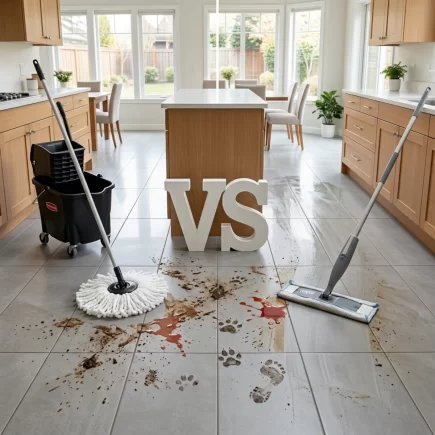









When it comes to keeping floors genuinely clean, not just clean-looking, the tool you choose matters more than people realize. A mop and bucket uses real water, cleaning solution, and physical scrubbing to lift dirt away from the floor entirely. A Swiffer relies on dry or lightly moistened pads that pick up surface dust but stop short of a true deep clean.
Both tools have a place in a cleaning routine, but one clearly does more of the heavy lifting. Understanding these differences helps you figure out which tool should be doing most of the work in your home.
Performance on Everyday Dust and Debris
For quick, light dust and pet hair, a Swiffer can be a convenient grab-and-go option. The dry pads pick up loose particles without needing water or setup time.
That said, a mop and bucket handles the same job just as well, and does it more thoroughly since the mop actually lifts and traps debris rather than relying on static cling. For anything beyond the lightest dust, a mop and bucket simply covers more ground.
- Swiffer: Fine for very light surface dust.
- Mop and bucket: Handles light dust and everything beyond it.
Handling Sticky Spills and Dried Grime
This is where the gap becomes obvious. A mop and bucket, with hot water and a proper cleaning solution, breaks down sticky residue and dried grime that a swiffer pad usually cannot fully remove.
A swiffer wet pad may soften a fresh spill, but dried grime often needs real scrubbing pressure, something a thin disposable pad was never designed to provide. For kitchens and dining areas especially, a mop and bucket is the more dependable tool.
Dirt Pickup Compared to Surface Wiping
A mop and bucket physically rinses dirt off the floor and into the water, so it gets removed from your home rather than just relocated. That rinsing step is the difference between cleaning and simply wiping.
A swiffer pad often struggles once floors get moderately dirty, sometimes smearing residue into streaks or pushing debris into corners instead of lifting it away. Frequent pad changes help, but they also add to the ongoing cost.
Prep and Cleanup Time for Each Option
A swiffer wins on speed, there is no denying that. But that speed comes with a tradeoff: a faster clean is often a shallower clean.
A mop and bucket takes a few extra minutes to set up and rinse afterward, but that time is what allows it to actually lift dirt rather than just pass over it.
| Task | Mop and Bucket | Swiffer |
| Setup time | 3 to 5 minutes. | Under 1 minute. |
| Cleanup time | 5 minutes. | Under 1 minute. |
| Cleaning depth | Thorough, water-based. | Surface level only. |
| Best for | Real dirt removal. | Quick surface pass. |
Hardwood, Tile, and Laminate Compatibility
Flooring type matters, but it is worth noting that a mop and bucket works on nearly every surface when used correctly. Tile, vinyl, and sealed hardwood all respond well to a properly wrung mop, and grout lines in particular get a far deeper clean than a dry pad can manage.
A swiffer is sometimes recommended for hardwood out of caution around standing water, but a well-wrung mop poses very little risk while delivering a much more thorough result.
- Tile and vinyl: Mop and bucket is the clear choice.
- Sealed hardwood: Mop and bucket, wrung out well.
- Grout lines: Mop and bucket reaches what a pad cannot.
Water Use and How Thorough the Rinse Gets
This is really the heart of the comparison. A mop and bucket uses standing water that gets changed or rinsed during cleaning, physically removing dirt instead of just relocating it across the floor.
A swiffer skips this step entirely, relying on a light spray or pre-moistened pad. That convenience comes at the cost of a genuinely deep clean, which is why floors can start to look dull faster with pad-only cleaning.
Weekly Deep Clean or Fast Daily Wipe Down
A swiffer can play a supporting role for fast touch ups between deeper cleans, but it should not be mistaken for a substitute. Most of the real cleaning work still falls to the mop and bucket.
Treating the mop and bucket as your primary tool, with a swiffer only for quick in-between passes, keeps floors consistently and genuinely clean rather than just tidy-looking.
Ease of Handling for Seniors and Joint Pain
A swiffer is lighter, which matters for some users. But modern mop and bucket sets, especially ones with wheeled buckets and wringer mechanisms, have closed much of that gap in recent years.
A quality mop and bucket set reduces wrist strain significantly compared to older designs, while still delivering the deeper clean that a lightweight pad simply cannot match.
Homes With Pets, Kids, or Constant Traffic
High-traffic homes are exactly where a mop and bucket earns its keep. Pet messes, tracked-in dirt, and daily wear and tear need real rinsing power to actually get removed, not just pushed around.
A swiffer can help in between deeper cleans, but relying on it alone in a busy household often means dirt gets managed rather than truly cleaned.
Closet Space in Apartments and Small Homes
Storage is a fair consideration, and a Swiffer does fold down compactly. That said, many mop and bucket sets today are designed with space-saving features like collapsible buckets and slim handles, making the storage gap smaller than it used to be.
For the cleaning performance it delivers, a mop and bucket remains a worthwhile use of closet space, even in smaller homes.
Disposable Pads and Landfill Consideration
This is one of the clearest long-term differences. Swiffer pads are disposable, which means ongoing cost and ongoing waste with every single use.
A mop and bucket uses a washable mop head that can be reused dozens of times before it ever needs replacing, making it both the more economical and more sustainable choice over time.
- Swiffer pads: Recurring purchase, recurring waste.
- Mop heads: Washable, reusable, lower long-term cost.
Pairing Both Tools Into One Routine
A swiffer can still earn a spot in your cleaning closet, mainly for quick pickups between deeper sessions. But it works best as a supporting tool rather than the main event.
The mop and bucket should carry the bulk of the responsibility, since it is the tool that actually removes dirt rather than just relocating it across the floor.
Picking the Better Match for Your Space
For most households, especially those with pets, kids, tile or hardwood flooring, or any real amount of foot traffic, a mop and bucket delivers a level of clean that a swiffer simply cannot match on its own.
A swiffer has its place for fast touch ups, but if you are choosing one tool to rely on, a quality mop and bucket set is the one that will actually keep your floors clean, not just looking clean.
A Mop and Bucket remains the better choice for thorough floor cleaning, while a swiffer is best suited for quick touch-ups between deeper cleans. Considering cleaning performance, long-term cost, and versatility across different floor types, a quality mop and bucket offers the most reliable solution for everyday household cleaning. Many households choose practical mop and bucket systems, such as those available from HOMCOM, when regular deep cleaning is part of their routine.
FAQs
A reusable mop head should be replaced when it becomes worn, frayed, or no longer cleans effectively. With proper washing and drying after each use, many mop heads last several months before needing replacement.
Most standard swiffer dry and wet pads are designed for single use and are not intended to be washed. While some people reuse dry pads for light dusting, doing so may reduce their ability to trap dirt effectively.
Rinse the mop thoroughly to remove dirt, then wash the mop head according to the manufacturer’s instructions. Allow it to dry completely before storing, as a dry mop is less likely to develop bacteria or unpleasant odors.
Sticky floors are often caused by using too much cleaning solution, failing to rinse properly, or leaving residue behind. Using the recommended amount of cleaner and clean water can help prevent this problem.