























Choosing between a dog crate and a dog carrier isn’t about brands or materials. It’s about function. These are two different tools designed for different parts of a dog’s life. Confusion happens when they’re treated as interchangeable.
The Core Difference: Home Base vs Transportation
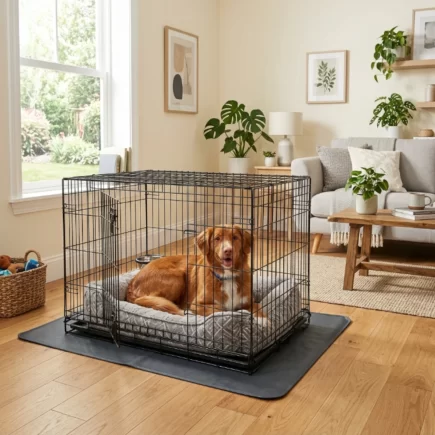
A dog crate is a stationary enclosure. It’s designed to stay in one place and act as a dog’s personal space for rest, sleep, and routine. Crates are built heavier and stronger because they are meant for repeated daily use at home.
A dog carrier is a transportation device. Its purpose is to move a dog safely from one location to another. Carriers prioritize light weight, compact size, and portability over long-term comfort.
If the dog is staying home, a crate makes sense. If the dog is going somewhere, a carrier is the correct tool.
What Each One Is Actually Used For
Crates excel at home-based needs:
- House training puppies
- Overnight sleeping
- Managing separation anxiety
- Post-surgery recovery
- Creating a predictable routine
Carriers are built for movement and access:
- Vet visits
- Car travel
- Air travel
- Public transportation
- Short errands and trips
Trying to force one tool to do the other’s job usually results in inconvenience or compromised safety.
1. Size Philosophy: Comfort vs Control
Crates and carriers follow different sizing logic.
Crate Sizing
Crates allow room for:
- Standing without hunching
- Turning comfortably
- Stretching while lying down
- Adding bedding or water bowls
This extra space supports longer periods of confinement without stress.
Carrier Sizing
Carriers are intentionally snug:
- Limited extra room
- Minimal internal movement
- Secure, enclosed feel during travel
A carrier that’s too large becomes unstable when carried, which defeats its purpose.
2. Materials and Build: Why Design Matters
Crates
- Wire and plastic models dominate
- Designed for airflow and durability
- Built to withstand repeated daily use
- Average lifespan ranges from 7 to 15 years
Carriers
- Soft-sided or hard-sided designs
- Built to reduce weight and bulk
- Designed for handling, lifting, and transport
- Typical lifespan ranges from 2 to 5 years, depending on frequency of use
Durability differences exist because the environments they face are completely different.
3. Security Focus: Containment vs Protection
Crates are designed to keep a dog contained:
- Reinforced frames
- Strong locking mechanisms
- Resistance to bending or chewing
Carriers are designed to protect a dog during movement:
- Secure closures
- Structural integrity during transit
- Attachment points for vehicle restraint
The goal is different, and the design reflects that.
4. Ventilation and Temperature Control
Crates rely on room airflow. Their larger openings work well in stable indoor environments but depend heavily on ambient temperature.
Carriers must balance airflow with structural support. Many meet airline ventilation standards and benefit from increased airflow during movement, but they are not meant for prolonged confinement in hot or stationary conditions.
Neither tool compensates for poor environmental conditions.
5. Portability: Why Weight Changes Everything
A typical wire crate can weigh 30–45 lbs empty. Once a medium-to-large dog is inside, moving it becomes impractical.
A carrier, by contrast, is designed to be carried:
- Lightweight construction
- Handles or shoulder straps
- Manageable total weight for short-to-medium distances
This difference alone determines which tool works for travel.
6. Home Use: Why Crates Are Better Indoors
At home, crates provide:
- Consistent placement for routine
- Adjustable sizing for growing puppies
- Space for extended rest
- A secure environment for anxious or destructive dogs
A Dog Carrier can work temporarily at home, but it lacks the space and durability needed for daily use.
7. Cleaning and Maintenance
Crates:
- Easier odor control due to ventilation
- Heavier and harder to move for cleaning
- Typically cleaned monthly
Carriers:
- Easier to wash
- Fabric models absorb odors more quickly
- Often cleaned after each use
Neither is maintenance-free, but crates require less frequent attention.
8. Storage and Living Space
Crates take up physical space even when folded. Many owners integrate them into living areas as semi-permanent fixtures.
Carriers are easier to store:
- Soft models fold flat
- Hard models fit on shelves or in closets
For small homes or apartments, storage considerations matter.
Can One Replace the Other?
- Using a crate for travel is technically possible but inconvenient and often unsafe.
- Using a carrier as a long-term home enclosure works only for very small, calm dogs and short durations.
Most compromises lead to frustration.
When Owning Both Makes Sense
Many dog owners eventually own both because their purposes don’t overlap.
You likely need both if:
- You’re training a puppy
- You travel occasionally
- You have a medium or large dog
- You want proper solutions rather than workarounds
You may only need one if your situation is extremely specific.
Dog crates and dog carriers are not competitors. One supports a dog’s daily life at home. The other enables safe, controlled movement through the world. The right choice isn’t about which is better. It’s about which problem you’re solving right now and whether your dog’s routine includes staying put or going places. If you’re ready to find the ideal crate for your dog, you can find the perfect crate on Aosom.
FAQs
1. How do I train my dog to use a crate or carrier?
Start by making the crate or carrier a positive space, using treats and toys to encourage exploration. Gradually increase the time your dog spends inside, and always reward calm behavior. Be patient and avoid using the crate as punishment.
2. Can I use a dog crate for a puppy?
Yes, you can use a dog crate for a puppy to help with house training and creating a safe space. Make sure the crate is appropriately sized, allowing your puppy to stand, turn, and lie down comfortably. Be mindful of the puppy’s growth and adjust the crate as needed.
3. How do I prevent my dog from escaping a carrier?
Ensure the carrier is securely latched and has escape-proof doors. Choose a carrier with reinforced, sturdy walls and use a locking mechanism that prevents your dog from opening it. Always check the door’s closure before use, especially during travel.
4. How do I know if my dog’s crate is the right size?
The crate should allow your dog to stand, turn around, and lie down comfortably. Measure your dog’s length and height to find the right fit, ensuring they have enough space but not too much, which can cause them to feel insecure. Always choose a crate that suits your dog’s breed and size.