














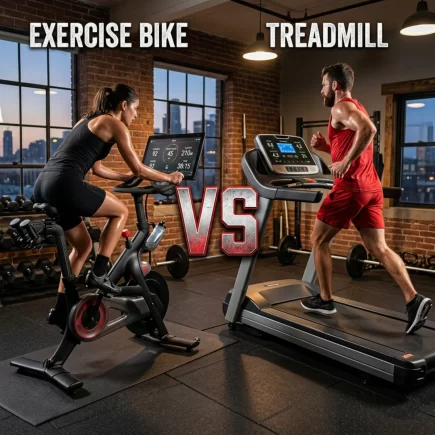









A rowing machine is the better choice if you want full-body conditioning, higher calorie burn, and efficient HIIT workouts. An exercise bike is the better choice if you want joint-friendly, beginner-accessible cardio with a massive library of online classes. The right pick comes down to your fitness goals, injury history, and how consistently you will actually use it.
What Muscles Does a Rowing Machine Work Compared to an Exercise Bike?
A rowing machine works around 86% of your muscles in every stroke. Legs, core, back, shoulders, and arms all fire together, making it one of the few cardio machines that trains the full body simultaneously. An Exercise Bike is almost entirely lower body quads, hamstrings, glutes, and calves do the work while your upper body stays passive.
| Muscle Group | Rowing Machine | Exercise Bike |
| Quads | ✓ | ✓ |
| Hamstrings | ✓ | ✓ |
| Glutes | ✓ | ✓ |
| Core | ✓ | Minimal |
| Back | ✓ | Minimal |
| Arms & Shoulders | ✓ | Minimal |
Which Burns More Calories: Rowing Machine or Exercise Bike?
A rowing machine burns more calories per hour because it recruits more muscle mass. More muscles working means more energy spent per session. However, the machine you use consistently will always outperform the one with better numbers that sits unused.
| Intensity | Rowing Machine (per hour) | Exercise Bike (per hour) |
| Low | 400–500 kcal | 300–400 kcal |
| Moderate | 500–650 kcal | 400–600 kcal |
| High | 700–900 kcal | 600–800 kcal |
Based on a 155 lb / 70 kg person.
Which Machine Is Easier on Your Joints?
Both are low-impact and safer than running. An exercise bike is gentler on the lower back, wrists, and spine since the movement is simple and repetitive with minimal load. A rowing machine can strain the lower back when form breaks down, particularly at the catch position under fatigue.
For knee problems, rowing actually keeps the knee bend within a safe range, making it a solid option. For lower back or hip sensitivity, a recumbent exercise bike is the safer starting point.
Which Machine Is Better for Rehab and Injury Recovery?
An exercise bike is the standard first choice in rehab. It requires no technique, delivers predictable joint load, and can be set to near-zero resistance for gentle recovery. Rowing is used in rehab for hip and upper body strengthening, but only after baseline fitness and form are established.
| Injury Type | Recommended Machine |
| Knee replacement | Exercise bike |
| Hip surgery recovery | Exercise bike |
| Lower back rehab | Recumbent bike |
| Shoulder injury | Exercise bike |
| General deconditioning | Bike first, rowing to progress |
Which Machine Is Easier to Learn for Beginners?
An exercise bike has almost no learning curve. Sit down, set resistance, and pedal most people are comfortable within two minutes. A rowing machine takes real time. The stroke has four phases: catch, drive, finish, recovery and incorrect sequencing reduces results and raises injury risk. Beginners should spend at least 30 minutes on technique before their first proper session to avoid bad habits that are hard to correct later.
Is a Rowing Machine or Exercise Bike Better for HIIT and Endurance?
Rowing is better matched to HIIT. Full-body recruitment spikes your heart rate fast, and short maximum-effort intervals produce strong cardiovascular results quickly. Exercise bikes are better for long endurance sessions. The seated position reduces supporting muscle fatigue, making 45 to 90 minute steady sessions far more sustainable and comfortable to maintain week after week.
| Training Style | Better Machine |
| HIIT intervals | Rowing machine |
| Zone 2 / steady-state | Exercise bike |
| Long endurance sessions | Exercise bike |
| Cross-training | Rowing machine |
Which Machine Has Better Screens, Classes, and Motivation Tools?
Exercise bikes win on content by a wide margin. Peloton, Apple Fitness+, and dozens of other platforms offer live and on-demand cycling classes with coaching, leaderboards, and music.
Rowing is catching up with platforms like Hydrow and Concept2’s online community, but the library is significantly smaller. If instructor-led classes are what keep you consistent, the exercise bike has a clear structural advantage in available content and community size.
Which Machine Takes Up Less Space in a Home or Apartment?
| Factor | Rowing Machine | Exercise Bike |
| Active footprint | ~8–9 ft long | ~4 ft long |
| Storage | Folds vertically | Rarely folds |
| Minimum room size | 10 x 6 ft | 6 x 4 ft |
A rowing machine has a larger active footprint but most models fold upright against a wall when not in use.
An exercise bike is more compact during use but typically stays in place permanently. For tight spaces, a foldable rowing machine can actually recover more floor space than a bike that never moves.
Who Should Buy a Rowing Machine and Who Should Buy an Exercise Bike?
Buy A Rowing Machine If:
- You want full-body conditioning from one machine
- You have healthy joints and no lower back issues
- HIIT and high-intensity training suits your schedule
- You are willing to spend time learning correct form
Buy An Exercise Bike If:
- You are managing joint sensitivity or recovering from injury
- You want beginner-friendly cardio with zero technique barrier
- Structured online classes keep you motivated and consistent
- Long steady-state cardio sessions match your training style
Should You Own Both a Rowing Machine and an Exercise Bike?
For most people, no. Both machines cover cardio effectively and owning both rarely doubles results. Space and budget rarely justify it. The exception is serious cross-training athletes or situations where one machine cannot be used due to injury. If budget and space genuinely allow, rowing for intensity days and cycling for recovery and endurance is an effective combination. For everyone else, pick one and commit to it fully.
Rowing Machine vs Exercise Bike: Final Verdict
A rowing machine is right if you want maximum efficiency, full-body results, and serious HIIT output in the shortest time per session. An exercise bike is right if you want something you can use every single day, that is gentle on your body, and connects to a large ecosystem of fitness content and classes.
| Decision Factor | Choose Rowing | Choose Bike |
| Primary goal | Full-body fitness | Cardio and lower body |
| Joint health | Good joints | Sensitive joints |
| Experience level | Intermediate+ | Any level |
| Preferred training | HIIT | Steady-state |
| Content and classes | Limited but growing | Extensive |
The machine you actually use every week is always the right machine.
Both Rowing Machine and exercise bike can improve cardiovascular fitness and support long-term health. Rather than chasing the highest calorie burn, focus on the machine that matches your comfort, goals, and routine. Consistency matters more than features; the best machine is the one you will actually use regularly.
FAQs
Yes, rowing strengthens the upper back, core, and posterior chain muscles that support proper posture. Regular training may help counteract the effects of prolonged sitting. Good rowing technique is important to achieve these benefits.
Noise levels depend on the resistance system. Magnetic exercise bikes are typically very quiet, while air rowers create a noticeable whooshing sound. If noise is a concern, check the resistance type before buying.
Both can work well for older adults, but exercise bikes are often preferred because they are easier to use and require less coordination. Recumbent bikes are especially popular for comfort and stability. The best choice depends on mobility and fitness level.