













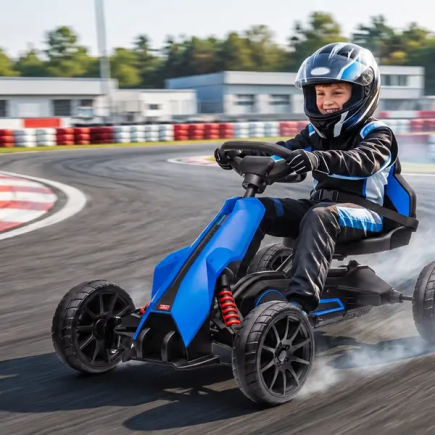

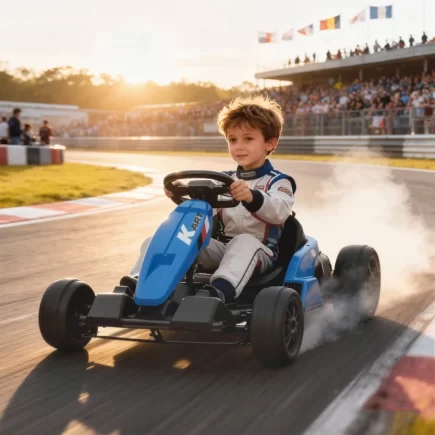
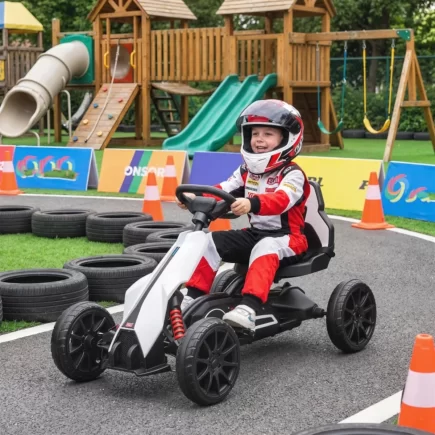
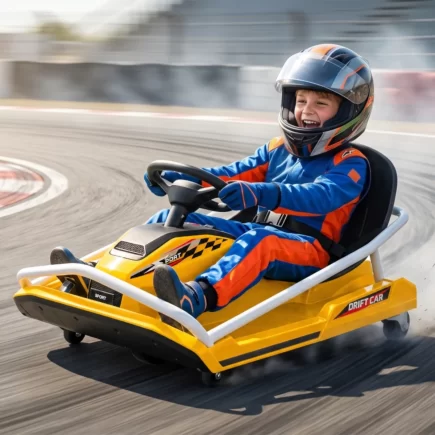
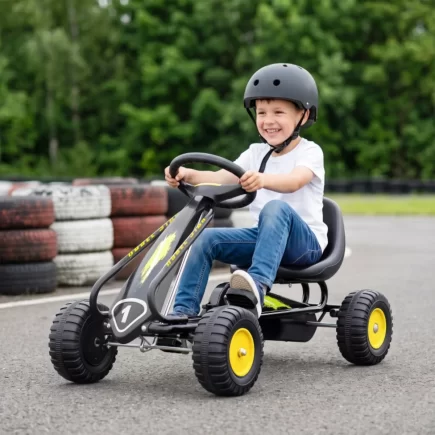

A kids go kart drifts because its rear wheels are built to lose grip before the front ones do, so the back swings wide while the front keeps steering. That behavior comes from the wheels, not from the label. A kart can carry a drift name, racing graphics and lights and still run the same wheels at both ends. A kart like that will not slide.
Three details on the product page settle it. The first two show how the kart slides, and the third shows whether it has the pace to do it.
- Rear tire material: One 24V model pairs high elastic PU front wheels with nylon banded rear drift tires.[1]
- Rear wheel size: One 12V model runs 6.25 inch front wheels against 2.75 inch rear wheels.[2]
- Top speed: The 24V model reaches 8.1 mph against the 12V model’s 5 mph, and a slide needs that kind of pace before either rear setup can let go.[1][2]
A beginner kart shows none of the three details. Its EVA wheels share one 9.8 inch diameter front and rear, its top speed is 3.1 mph and it carries no drift function.[3] When a drift model costs more, those three details are what the extra money buys.
What Does Drifting Mean on a Kids Go Kart?
It means the driver is steering and sliding at the same time. The front wheels keep their grip and set the direction, while the rear wheels let go and swing wider than the line the front wheels are following. Holding the slide there takes steering and speed together.
How a Kart Produces the Slide
Two karts can both carry the word drift in the product name and slide in very different ways. The rear wheels are where the difference lives, and a listing describes them in two ways, material and size.
The Rear Tires
Grip comes from the tread in contact with the ground, which is what keeps a vehicle from slipping and sliding.[4]
- Some drift karts give the front and rear different grip on purpose. The 24V model runs high elastic PU at the front and nylon banded drift tires at the rear, so the two ends do not hold the same way.[1]
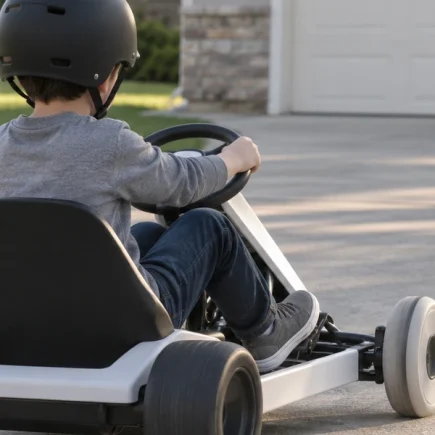
- The beginner kart uses one material at both ends.[3]
Rear Wheel Size Against the Front
Size does the same job by another means, with a rear wheel far smaller than the one at the front.
- On the 12V drift model the rear wheel is less than half the diameter of the front, with a separate 2 inch auxiliary wheel making up the rest of the rear package.[2]
- The 24V model does not lean on size the same way. Its rear wheel is larger than the front, 11 inches against 8.7, but the tire material is what separates its two ends.[1]
Is the Drift Mechanical or Just Styling?
It is mechanical when the specification shows a difference at the rear. The rear wheel entry is what settles it, because the slide has to come from something at the back that the front does not match.
| Design | Front wheel, diameter and material | Rear wheel, diameter and material | Top speed |
| Material based drift, 24V[1] | 8.7 in, high elastic PU | 11 in, nylon banded drift tires | 8.1 mph |
| Small rear wheel drift, 12V[2] | 6.25 in, PU | 2.75 in, PU | 5 mph |
| Beginner kart, 12V[3] | 9.8 in, EVA | 9.8 in, EVA | 3.1 mph |
Two of the three fit a rear wheel the front does not match, in material or in size. The beginner kart runs the same 9.8 inch EVA wheel at both ends, and nothing in that package is set up to let go.
The battery rating is not the dividing line. The 12V drift model and the beginner kart run the same 12V 7AH battery, and only one of them is built to slide.[2][3]
How Much Speed Does a Drift Need?
Enough to overcome whatever grip the rear tires still have, which is why a drift build is not found at the slow end of the range. The beginner kart tops out at 3.1 mph, while the two drift karts reach 5 and 8.1 mph.[1][2][3]
For context on what counts as fast here, CPSC staff has asked ASTM to consider maximum speed requirements for ride-on toys. The letter points to the European toy standard, which limits ride-on toys intended for children of 6 years and older to 9.9 mph.[6] Both drift examples sit under that figure.
For a closer look at where the 12V speeds land, see Best 12V Electric Go-Karts for Kids.
How Drifting Changes the Everyday Ride
A drift kart’s rear end is set up to give away some of its grip, and that holds everywhere, not only at the corners. That is the trade the hardware makes.
The kart also sits close to the ground. The seat on one 24V drift model sits 7.5 inches high against an overall height of 21.3 inches, which puts the driver inside the kart rather than on top of it.[1]
Run time comes with the package. The 24V drift example runs 40 minutes on a charge and the 12V drift model 30.[1][2] The beginner kart runs 50.[3] Run time comes down to the battery and motors rather than the drift setup, but it is still part of the package.
Where a Drift Kart Slides and Where It Will Not
A slide works best on a smooth, hard, level surface. Loose ground defeats the design, and grass or gravel stops the slide before it starts. A slope adds speed the driver did not ask for.
Stick to paved ground such as asphalt or concrete.[3]
A sliding kart also travels wider through a turn than one that holds its line, so the whole turning area needs to be clear of walls, parked cars, planters and anything else a kart could reach sideways. Check the surfaces and conditions the manufacturer approves before riding anywhere new.
Two Drift Karts Compared
The two examples below show the two drift designs. They are not recommendations.
| Feature | Example 1 | Example 2 |
| Name of Product | Qaba 24V Drift Kart[1] | Aosom 12V Electric Drifting Go Kart[2] |
| Product Code | 370-446V80RD | 370-307V80BK |
| Route to the slide | Different rear tire material | Much smaller rear wheel |
| Motors | Dual 24V | Not stated |
| Battery | Two 12V 7AH batteries, 24V combined | One 12V 7AH battery |
| Weight capacity | 154 lbs | 110 lbs |
Example 1 changes what the rear tire is made of, from PU at the front to nylon banded drift tires at the back. Example 2 keeps PU at both ends and makes the rear wheel less than half the diameter of the front.
Weight capacity is worth checking against the child rather than against the age rating. Example 1 is rated to 154 lbs and Example 2 to 110 lbs, a gap of 44 lbs between two karts aimed at the same age group.[1][2]
Choosing the Right Kart for Your Child
The higher price pays for the rear wheel setup, either a different material or a much smaller size, plus the speed to use it. In return the kart has less grip everywhere, needs a smooth hard surface and runs for less time on a charge.
That is worth it for a child who wants to learn to hold a slide, and not for one still learning to steer straight. The wheel figures on the product page tell you which kart you are looking at.
FAQs
A karting or motorcycle helmet built to Snell or DOT standards, not a bicycle helmet. The CPSC lists karting among motorized wheeled activities and names this type of helmet for it.[5] It also advises checking the label or marking that states which standard a helmet meets, rather than relying on the packaging.
Usually older children. Both drift karts here are rated for ages 8 to 12, while the beginner kart is rated 3 to 8.[1][2][3] These ranges come from the manufacturer, so a drift kart is not a fit for a younger child, even at a tempting price.
The idea is the same, but the method is not. Both rely on the rear losing grip while the front steers. In motorsport, the driver creates the slide through technique at much higher speed, while a kids kart has the slide built into its rear wheels.
Not on these karts. The rear wheel setup is fixed, so the speed setting changes how fast a child goes, not how much grip the rear wheels have.
No. These karts are built for a child’s size and weight, and an adult rider puts load on a frame, wheels and motors that were not designed to carry it. Check the approved age and use on the listing first.
References
[1] Qaba 24V 7AH Kids Electric Go Kart, 8.1 MPH Battery Powered Drift Kart with Dual Motors, Soft Start for 8-12 Years, Aosom.
https://www.aosom.com/item/qaba-24v-7ah-kids-electric-go-kart-8-1-mph-battery-powered-drift-kart-with-dual-motors-soft-start-for-8-12-years-red~21P3EKHTK8000.html
[2] Aosom 12V Electric Drifting Go Kart w/ Slow Start, Music, Lights, Aosom.
https://www.aosom.com/item/aosom-12v-drift-kart-electric-go-kart-with-slow-start-music-colorful-lights-for-8-12-years-old-black~1JAGMSL941G01.html
[3] Aosom 12V Electric Go Kart for Kids, Ride On Toy with EVA Tires, 2 Speeds, Adjustable Seat, Safety Belt for 3-8 Years, Aosom.
https://www.aosom.com/item/aosom-12v-electric-go-kart-for-kids-w-adjustable-speed-white~1IEQL2JQK6G01.html
[4] Tire Safety Ratings and Awareness, National Highway Traffic Safety Administration.
https://www.nhtsa.gov/vehicle-safety/tires
[5] Which Helmet for Which Activity, U.S. Consumer Product Safety Commission.
https://www.cpsc.gov/s3fs-public/349-WhichHelmetBrochure_5-13-22_WEB_508.pdf
[6] Letter to ASTM F15.22 Subcommittee on ride-on toys, U.S. Consumer Product Safety Commission.
https://www.cpsc.gov/s3fs-public/11-2-22-Letter-to-ASTM-Ride-on-Toys.pdf