
















Automatic chicken coop doors make opening and closing the coop easier by operating without manual effort. They use timers or light sensors to determine when the door should move. A motor then powers the opening and closing mechanism. But how does the whole system work from trigger to movement?
What Is an Automatic Chicken Coop Door?
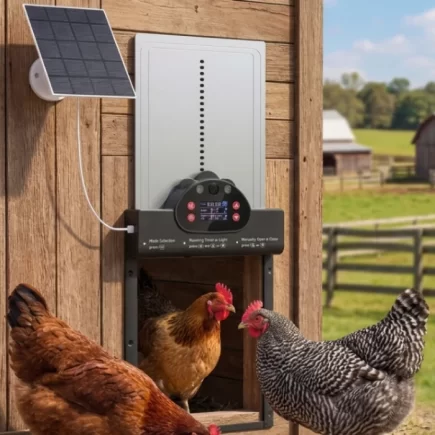
An automatic chicken coop door is a motorised door system designed to open and close a chicken coop entrance at predetermined times or in response to changing daylight. It automates the daily process of letting chickens out in the morning and securing them inside later in the day.
Unlike a manually operated coop door, the system can perform these movements without the keeper being present.
How Does an Automatic Chicken Coop Door Work?
An automatic coop door follows a simple sequence. A timer or light sensor provides the trigger, the controller processes the signal, and the motor moves the door. Once the door reaches its open or closed position, a limit switch, sensor, or control system stops the motor.
| Stage | What Happens |
| Trigger | A timer or light sensor determines that the door should operate. |
| Signal | The controller receives the trigger and activates the motor. |
| Movement | The motor drives the mechanism that opens or closes the door. |
| Position Detection | A switch or sensor detects when the door reaches its intended position. |
| Stop | The controller stops the motor. |
The complete process can therefore be simplified to:
Trigger → Controller → Motor → Door movement → Position detection → Stop
Main Components of an Automatic Coop Door
Although designs differ, most automatic chicken coop doors rely on several basic components.
| Component | Purpose |
| Door panel | Provides access to and security for the coop opening. |
| Motor | Supplies the force needed to move the door. |
| Controller | Processes signals and controls the motor. |
| Timer | Triggers operation at programmed times. |
| Light sensor | Detects changes in outdoor brightness. |
| Power source | Supplies electricity to the motor and controls. |
| Track or guide | Keeps a sliding door aligned during movement. |
| Limit switch or position sensor | Detects when the door has reached its operating position. |
Not every model uses every component in exactly the same way. The design depends on the type of door and its control system.
How Does the Door Know When to Open and Close?
The door needs a signal telling it when to operate. Most systems use either light levels, preset times, or a combination of both.
A light-sensing system monitors the brightness around the coop. When the light reaches the programmed threshold, the controller triggers the door.
A timer uses an internal clock instead. The keeper sets specific opening and closing times, and the controller activates the motor according to that schedule.
Light Sensors and Timers
The two methods work differently and can affect the door’s daily schedule.
| Control Method | Operation | Advantage | Limitation |
| Light sensor | Responds to changes in daylight. | Automatically follows seasonal daylight changes. | Unusual outdoor lighting can affect some systems. |
| Timer | Uses preset opening and closing times. | Provides a predictable schedule. | May need seasonal adjustments. |
| Combined control | Uses timing and light conditions together. | Offers greater control over operation. | More settings to manage. |
Power Sources: Battery, Solar, or Plug-In
The motor and controller need electricity to operate. Automatic coop doors commonly use batteries, solar-charged batteries, or a household power connection.
- Battery-powered systems are useful where the coop has no access to mains electricity. The battery must be checked and replaced or recharged when necessary.
- Solar-powered systems use a solar panel to recharge a battery. This can suit outdoor or remote coops, although charging depends on available sunlight.
- Plug-in systems use household electricity and can provide a consistent power supply where a suitable outlet is available.
The power source does not change the basic operating sequence: the controller still triggers the motor, and the motor moves the door.
Motors, Pulleys, and Track Systems
The motor is responsible for converting electrical energy into mechanical movement. In many vertical sliding doors, the motor turns a pulley or spool connected to a cord or cable attached to the door.
As the motor turns in one direction, the door rises. When it turns in the opposite direction, the door lowers.
Other automatic doors may use gears, linear actuators, or different drive mechanisms. Guide rails or tracks keep the moving panel aligned and help prevent it from catching during operation.
The Automatic Opening and Closing Cycle
Once the controller receives the correct trigger, the motor begins moving the door. The mechanism continues until the door reaches its programmed end position.
For a typical closing cycle:
- The timer reaches the programmed closing time or the light level falls to the required threshold.
- The controller activates the motor.
- The motor drives the door downward.
- The door reaches the closed position.
- A limit switch or position sensor detects the position.
- The controller stops the motor.
The opening cycle works in the same way, with the motor moving the door in the opposite direction.
How Do Automatic Coop Doors Keep Chickens Safe?
Safety depends on both the door’s design and its correct installation. Some automatic doors include mechanisms that detect resistance or an obstruction during closing and stop or reverse the movement.
The door should also have enough clearance around its moving parts to reduce the risk of chickens becoming trapped.
Safety features vary between models, so it is important to follow the manufacturer’s installation and operating instructions rather than assuming every automatic door has the same protection.
What Happens If the Power Fails?
If the power source becomes unavailable, the door may not complete its scheduled movement. The result depends on how the particular system is powered and whether it has backup features.
Battery-powered doors can continue operating while sufficient charge remains. Solar systems generally store energy in a rechargeable battery, allowing operation when the solar panel is not actively generating power.
Some models may also provide low-battery warnings, backup power, or other alerts.
Tip: Test the door regularly and check its power source before periods when access to the coop may be difficult.
Manual Override and Backup Control
Many automatic coop doors include a manual control that allows the keeper to open or close the door without relying on the normal schedule.
This can be useful when inspecting the coop, changing the routine, carrying out maintenance, or dealing with an unexpected situation.
Some models also provide remote control or smartphone connectivity. Depending on the system, this may allow the keeper to operate the door or change its schedule remotely.
Predator Protection
One of the main practical benefits of an automatic coop door is that it can help secure chickens inside the coop after they have gone in for the night.
The door itself should close fully and resist attempts to push or lift it from outside. Some designs use locking mechanisms, enclosed tracks, gears, or other features to prevent forced opening.
However, an automatic door cannot protect the flock if there are other openings or weak points in the coop. The walls, roof, windows, and surrounding structure should also be properly secured.
Installing an Automatic Chicken Coop Door
Installation varies by model, but a typical setup involves mounting the door and its guide system, connecting the motor and power supply, and programming the operating controls.
| Installation Step | What to Check |
| Measure the opening | Confirm that the door fits the coop entrance. |
| Mount the door | Ensure the panel is positioned correctly. |
| Install the track | Keep the guide system straight and secure. |
| Attach the motor | Connect the drive mechanism according to the instructions. |
| Connect power | Install the battery, solar system, or power adapter. |
| Test movement | Check that the door opens and closes smoothly. |
| Set controls | Program the timer or light-sensor settings. |
| Run test cycles | Confirm that the door stops correctly in both positions. |
Correct alignment is particularly important for sliding doors. A poorly aligned track can cause resistance, uneven movement, or incomplete closing.
Maintenance and Common Problems
Automatic doors contain moving parts and electrical components that should be checked regularly. Keep the door and track free from bedding, feathers, mud, ice, and other debris that could interfere with movement.
| Problem | Possible Cause | What to Check |
| Door does not move | Low battery or power problem | Check the power source and connections. |
| Door stops during movement | Obstruction or track problem | Inspect and clean the moving area. |
| Door operates at the wrong time | Incorrect timer or sensor setting | Check the programmed controls. |
| Door becomes noisy | Dirt or worn components | Inspect the motor and moving parts. |
| Door does not close completely | Obstruction or misalignment | Check the door, track, and opening. |
Follow the manufacturer’s maintenance instructions for cleaning, lubrication, battery replacement, and component adjustments.
Choosing an Automatic Coop Door also means considering reliability, power supply, safety, and the conditions around the coop. Regular checks can help keep the mechanism working smoothly and reduce unexpected problems. With proper setup and maintenance, the system can make daily chicken care more consistent and convenient.
FAQs
Many automatic doors can operate throughout winter, but performance depends on the model and weather conditions. Battery-powered units may need more frequent checks in cold weather. Keep the mechanism clear of ice, snow and debris.
Battery life varies according to the door, battery type and operating frequency. Some systems can run for several months before replacement is needed. Checking the battery regularly helps prevent the door from failing.
Chickens naturally tend to return to their coop around dusk as daylight decreases. An automatic door does not usually need to guide them inside. It’s important to train young or newly introduced chickens to return to the coop before relying on automation.