


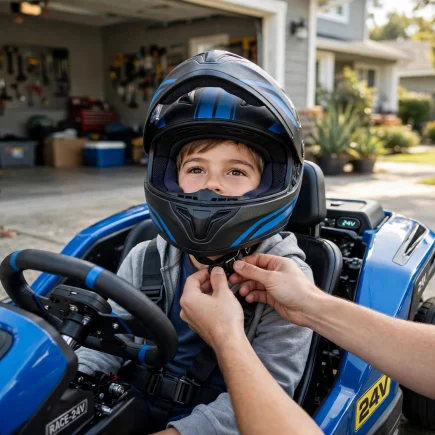





Yes, a helmet is worth wearing on a kids go kart. CPSC advises safety gear, including helmets, for scooters and other riding toys, which is the nearest federal guidance for kids’ karts.[1] CPSC’s Toys page and helmet brochure do not name a helmet standard for pedal or battery karts, so pick a helmet made for a matching activity and check the fit.[2]
- Is it required: Neither CPSC’s Toys page nor its helmet brochure names a helmet requirement for pedal or battery karts.[1][2] State and local rules and the kart manual may differ, so check them too.
- Which type: CPSC says there are different helmets for different activities. It lists karting helmets for karting and bicycle helmets for kick scooters.[2]
- Fit: Once on the head, the helmet should not move in any direction.[2] It should also sit level, one or two finger-widths above the eyebrow.[3]
- Replace: After a crash, even when no damage shows, for single-impact helmets such as bicycle helmets.[2][3]
- Before you buy: Check the label for the standard, because CPSC says not to rely on a helmet’s name, looks or packaging claims alone.[2]
Do Kids Need a Helmet to Ride a Go Kart?
CPSC’s toy page says to get safety gear, including helmets, for scooters and other riding toys, and to make sure children use it all the time.[1] The page does not name go karts, so treat it as general riding-toy advice.
Neither CPSC’s Toys page nor its helmet brochure sets a helmet requirement for pedal or battery karts. State, local and park rules can differ, and a kart’s manual may ask for a helmet, so check both before the first ride.
Which Type of Helmet Suits a Kids Go Kart?
No single helmet is listed for kids’ pedals or battery karts. CPSC’s brochure groups helmets by activity and says helmets designed for other activities may not protect the head as effectively.[2] The table shows the rows closest to a kids go kart.
| Activity | Helmet type listed | Standards listed |
| Karting or go-karting | Karting or motorcycle | Snell K2020, SA2020, M2020, CM2016 and DOT FMVSS 218[2] |
| Kick scooter riding | Bicycle | ASTM F1447, F1898, Snell B-90, B-95, N-94 and CPSC 16 CFR 1203[2] |
| Pedal or battery kids’ kart (no CPSC row) | Not listed | The brochure has no row for this activity[2] |
- Karting helmets: The brochure notes that a helmet meeting CM2016 was designed specifically for children’s motorsports.[2]
- Bicycle helmets: Bicycle helmets made after 1999 must meet the CPSC standard in 16 CFR part 1203.[2] The standard applies to helmets marketed for bicycle riders, and helmets marketed for exclusive use in an activity such as skateboarding are not covered by it.[4]
- Multi-sport helmets: Only a few helmets suit more than one activity. CPSC gives a CPSC-compliant bicycle helmet for bicycling, recreational skating or kick scooters as an example.[2]
One reading of the brochure, not a ruling, is that the karting row sits under wheeled activities with a motor, so it is the closest listed match for a kart with a gas engine. The brochure has no row for battery karts, so the manual and the helmet maker’s stated use are the guide.
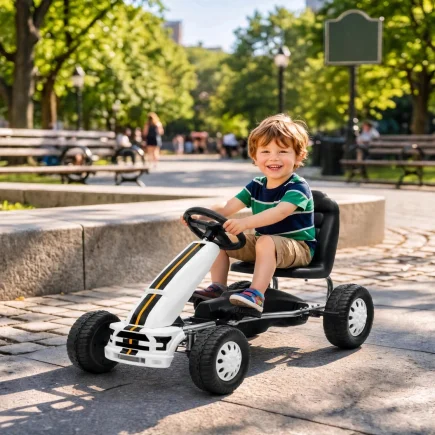
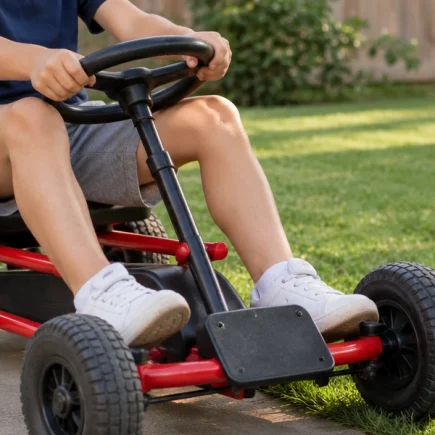
For a pedal kart, the nearest non-motor wheeled activity listed is kick scooter riding, which names a bicycle helmet. The Toys page groups scooters with other riding toys, so that row is the nearest match, subject to the kart’s manual.
How Do You Check That a Helmet Fits a Child?
NHTSA’s fitting guide is written for bike helmets. CPSC’s brochure gives a similar test, that once on the head the helmet should not move in any direction.[2] Use these five checks, and follow the maker’s instructions where a karting helmet differs.
- Level and low: Set the helmet level on the head, one or two finger-widths above the eyebrow.[3]
- Side straps: Adjust them to form a V under and slightly in front of each ear.[3]
- Chin strap: Tighten it until it is snug, so no more than one or two fingers fit under it.[3]
- Open mouth test: Ask the child to yawn wide. The helmet should pull down on the head, and if not, tighten the chin strap.[3]
- Rock test: The helmet should not rock forward, backward or side to side. If it rocks more than an inch, readjust it.[3]
Buy a helmet that fits now. NHTSA says not to buy one to “grow into”.[3] Repeat the checks with your child seated in the kart, and read the helmet’s own manual for sizing.
When Should a Kids Helmet Be Replaced?
- After a crash: CPSC says a single-impact helmet, such as a bicycle helmet, must be replaced after a crash even when there are no visible signs of damage.[2] NHTSA adds that damage is not always visible.[3]
- With age: If the maker gives no replacement guidance, CPSC says it may be prudent to replace a helmet within 5 to 10 years of purchase.[2]
- After growth: When a helmet stops passing the five fit checks, it may no longer fit the child, so check the maker’s sizing guidance.
What Does the Evidence Show and Not Show?
The rows below summarize what each source says. They are guidance and survey figures, not a legal reading of any rule.
| Topic | What the source says | Source |
| Riding toy advice | Get safety gear, including helmets, for scooters and other riding toys, and make sure children use it all the time. | CPSC Toys page[1] |
| Gas go-kart injuries | An estimated 12,600 children under 15 were treated in emergency rooms for injuries associated with go-karts in 1999. The report defines a go-kart as a gasoline powered motorized vehicle. | CPSC go-kart report, 2000[5] |
| Helmet use | In a five-month 1999 telephone survey of injured operators (70 responses), 53 percent wore a helmet, 34 percent did not and 13 percent were unknown. | CPSC go-kart report, 2000[5] |
| What the survey cannot show | It counted injured operators only, so it cannot show whether helmets prevented injuries. | Limit of the data |
| Helmet type for pedal or battery karts | The brochure’s activity table has no row for them. | CPSC brochure[2] |
| Helmet label | Do not rely solely on a helmet’s name, appearance or packaging claims. | CPSC brochure[2] |
Worked Example: What Do Two Aosom Electric Karts Say About Helmets?
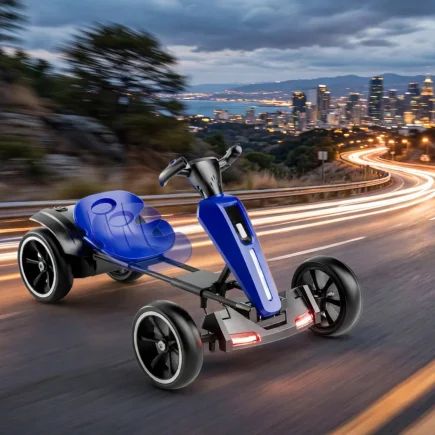
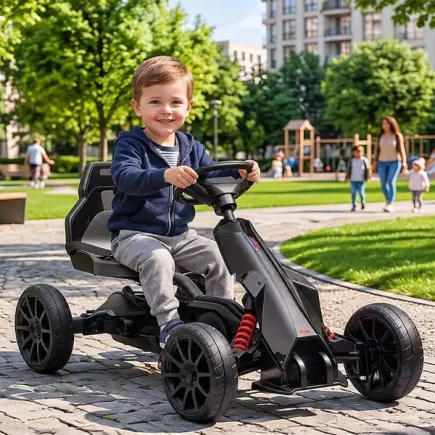
Two Aosom Electric Go Karts show what a listing does and does not say. The Qaba 24V Electric Go Kart[6] and the Aosom 12V Electric Go Kart[7] both give an age range, a load limit and a speed, and neither listing mentions a helmet.
| Feature | Qaba 24V Electric Go Kart | Aosom 12V Electric Go Kart |
| Recommended age | 6 to 12 years | 3 to 8 years |
| Listed speed | 3.7 to 11.2 mph | 1.9 to 3.1 mph |
| Maximum load | 110 lbs | 66 lbs |
| Helmet wording | None listed | None listed |
| Supervision wording | Adult supervision recommended | Always monitor your children while they are riding |
- Same silence, different speeds: The Qaba kart’s top listed speed is 11.2 mph against 3.1 mph for the Aosom 12V kart, yet neither page says which helmet to wear. The kart’s manual, if it covers helmets, and the helmet’s own label are the places to look.
- What to do: Read the manual before the first ride, and ask the seller if it is silent on helmets.
- Supervision: Both pages ask for adult supervision in some form, so helmet checks fit into the same routine before each ride.
- Price and delivery (Aosom 12V Electric Go Kart): Priced at $147.99 at time of writing, with free standard delivery to U.S. addresses. Contact us within 30 calendar days of delivery to return it.
- Price and delivery (Qaba 24V Electric Go Kart): Priced at $254.99 at time of writing, with free standard delivery to U.S. addresses. Contact us within 30 calendar days of delivery to return it.
What Mistakes Do Parents Make With Kids Helmets?
- Skipping it on short rides: CPSC says to make sure children use safety gear all the time.[1]
- Choosing by age, not fit: A shelf label does not replace the five fit checks above.[3]
- Reading silence as advice: A listing with no helmet wording is not advice either way, as the two Aosom pages show.
- Treating survey figures as proof: The go-kart survey covered injured gas-kart operators, so it says little about pedal or battery karts.[5]
Your Child’s Safety Comes First
A helmet is worth wearing on a kids go kart, and CPSC advises helmets for scooters and other riding toys. Neither CPSC’s Toys page nor its helmet brochure names a helmet standard for pedal or battery karts.
One reading of the brochure is that a karting helmet suits a gas kart and a CPSC-compliant bicycle helmet is the nearest listed match for a pedal kart. For a battery kart, follow the manual and the helmet maker’s stated use. Run the five fit checks, replace the helmet after a crash and follow the supervision wording on the product page.
FAQs
A helmet is worth wearing. CPSC advises safety gear, including helmets, for scooters and other riding toys, although its Toys page does not name pedal karts. Neither that page nor the helmet brochure sets a helmet requirement for them, so check state and local rules and the manual.[1][2]
Possibly, for a pedal kart. CPSC lists a bicycle helmet for kick scooter riding and says only a few helmets suit more than one activity. The brochure has no row for kids’ karts, so check the kart manual and the helmet label.[2]
A karting helmet is one made for go-karting. CPSC’s brochure lists Snell K2020, SA2020, M2020, CM2016 and DOT FMVSS 218 for karting. A CM2016 helmet was designed specifically for children’s motorsports, so check the label for the standard.[2]
Snug enough that no more than one or two fingers fit under the chin strap, with the helmet level and one or two finger-widths above the eyebrow. It should pull down when the child yawns and should not rock more than an inch.[3]
See also
References
[1] Toys – U.S. Consumer Product Safety Commission.
https://www.cpsc.gov/Safety-Education/Safety-Education-Centers/Toys
[2] Which Helmet for Which Activity? (Publication 349) – U.S. Consumer Product Safety Commission.
https://www.cpsc.gov/s3fs-public/349-WhichHelmetBrochure_1-6-2026_WEB_508.pdf
[3] Fitting Your Bike Helmet (DOT HS 811 568, April 2012) – National Highway Traffic Safety Administration.
https://nhtsa.gov/node/2711
[4] Bicycle Helmets Business Guidance – U.S. Consumer Product Safety Commission.
https://www.cpsc.gov/Business–Manufacturing/Business-Education/Business-Guidance/Bicycle-Helmets
[5] Go-Kart Related Deaths and Injuries to Children – U.S. Consumer Product Safety Commission, September 2000.
https://www.cpsc.gov/s3fs-public/pdfs/go-kart.pdf
[6] Qaba 24V Electric Go Kart with Dual 150W Motors, Adjustable Seat & 11.2MPH High Speed, Slow Start, 5-Point Harness, Blue | Aosom.
https://www.aosom.com/item/qaba-24v-electric-go-kart-with-dual-150w-motors-adjustable-seat-11-2mph-high-speed-slow-start-5-point-harness-blue~22TA5GEKC7O00.html
[7] Aosom 12V Electric Go Kart for Kids, Ride On Toy with EVA Tires, 2 Speeds, Adjustable Seat, Safety Belt for 3-8 Years, Blue | Aosom.
https://www.aosom.com/item/aosom-12v-electric-go-kart-for-kids-ride-on-toy-with-eva-tires-2-speeds-adjustable-seat-safety-belt-for-3-8-years-blue~2748NUGPSBO00.html