


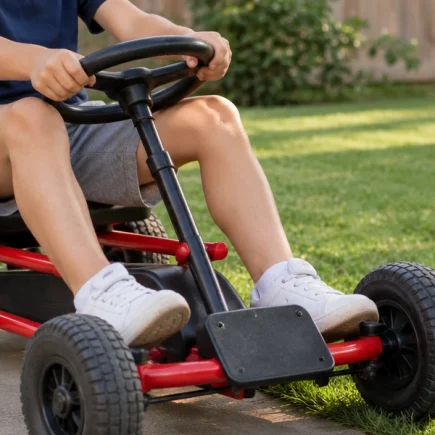
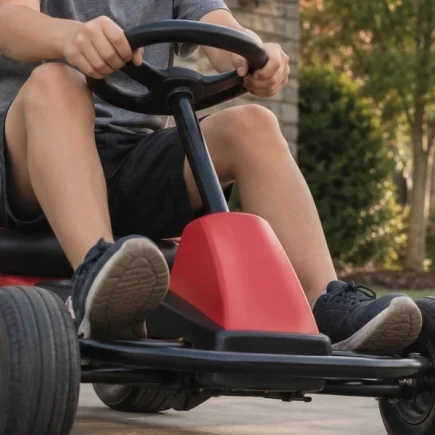
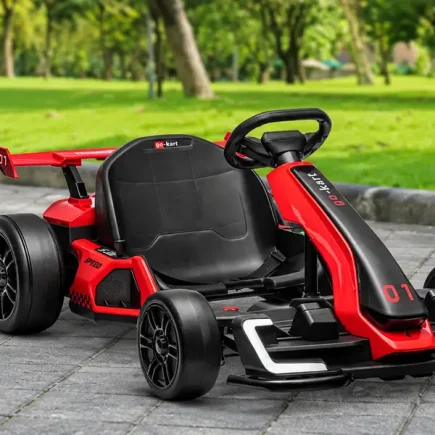



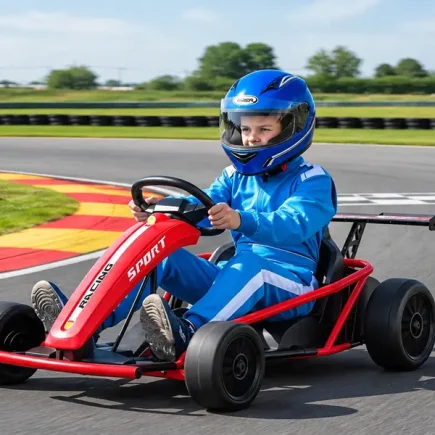
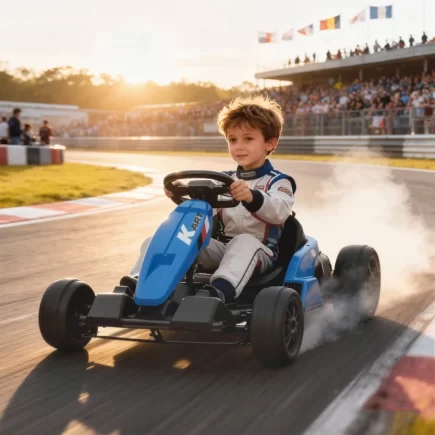
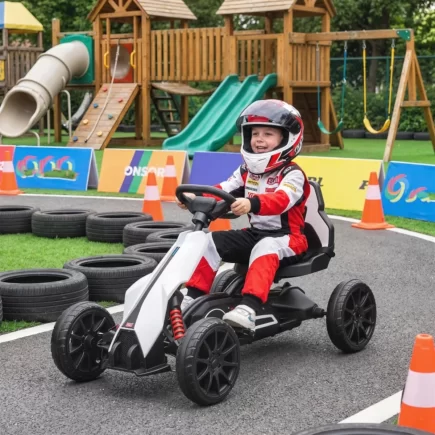
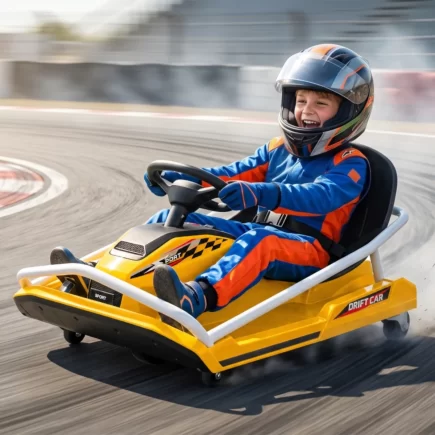
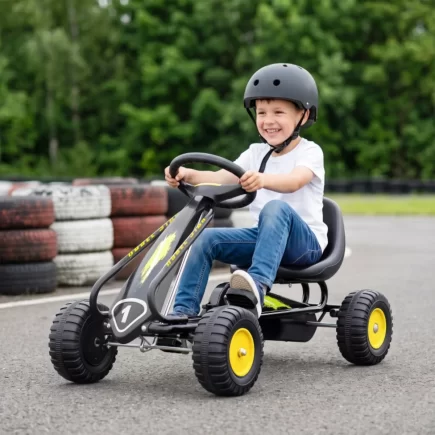

Yes, but only on short, dry, level grass. A kids electric go kart is made for hard, smooth ground such as asphalt and concrete.[4][5] On grass, the wheels sink slightly and lose grip, so a kart that runs well on the driveway often slows or stalls once it reaches the lawn.
What to expect depends on the grass and how level it is.
- Short, dry, level grass: The best chance of a usable ride, though it is still harder going than pavement.
- Long or wet grass: The ground gets heavier as the grip gets worse, and this is where most karts stop moving.
- Slopes: Best avoided, since the safety warning required on battery-powered ride-on toys names steep inclines.[1]
None of this means a home with a lawn is a poor fit. It moves the riding onto the hard ground you already have, such as the driveway, patio or paths, and leaves the grass as a short crossing rather than a track.
Why Does a Kids Electric Go Kart Stall on Grass?
Because turf asks for more effort than the motor has spare. Three things explain it once the wheels leave the pavement.
- Turf gives way underneath: A wheel typically sinks slightly and pushes a small ridge of grass ahead of it, so a growing share of the motor’s effort goes into pressing through the surface rather than moving the kart forward.
- The wheels are built for hard ground: The 12V kart runs EVA wheels of 9.8 inches. The 24V runs EVA at the front and nylon at the rear, at 8.25 and 10.75 inches.[4][5]
- Traction wording is worth reading closely: Both pages use the word traction. The 24V claims it on unforgiving terrain, and the 12V claims it without inflation.[4][5] Neither page names grass anywhere. Where a loose description and a named surface disagree, the named surface is the one to go by.
Voltage and sizing are a separate question from surface, and When to Upgrade Your Child’s Go-Kart From 12V to 24V covers them.
What Does the Toy Safety Standard Say About Slopes and Roads?
More than the product pages do. ASTM F963 is the mandatory federal toy safety standard, carried into federal regulation at 16 CFR part 1250.[2] The 24V listing states ASTM F963 and CPSIA qualification.[5]
The standard sets a warning that a battery-powered ride-on toy has to carry. In the publicly readable 2011 edition it must convey, at a minimum, that the toy should never be used:
- In roadways or near motor vehicles
- On or near steep inclines or steps
- Near swimming pools or other bodies of water
It must also convey that shoes should always be worn, and that no more than the stated number of riders should be carried.[1] Elsewhere the standard describes these toys as not intended for streets or roadways.[1]
The steep inclines clause is the one that matters on a lawn. The standard does not define steep, and no gradient appears on either listing, so the practical answer is to use the flattest ground available rather than to look for a number to measure against.
A slope changes stopping as much as starting. On grass the wheels have less to push against, so a kart carrying speed downhill takes longer to slow, and a kart pointed uphill can lose grip and roll back.
The manual for each kart can be downloaded from its product page, and that is where the full warning for a given model appears.
Which Surfaces Can a Kids Electric Go Kart Handle?
Here is what to expect on common surfaces, and the last three are ruled out by the standard’s warning.
| Surface | What to expect | What that rests on |
| Asphalt, concrete, cement | The ground the kart was built for | Named on both listings[4][5] |
| Patio slabs and paved paths | Workable where the slabs sit level | The same hard material as the named surfaces |
| Short, dry, mown grass | The version worth trying | No listing names it and no warning rules it out |
| Long or wet grass | Where a kart slows and stops | More to push through and less to push against, with water close to the electrics |
| Loose gravel or soft dirt | Wheels dig rather than push | Loose material shifts under a smooth wheel instead of pushing back |
| Any steep incline or step | Ruled out | Named in the warning the standard requires on these toys[1] |
| Roadways or near traffic | Ruled out | The same warning, plus the scoping of these toys as not intended for roadways[1] |
| Near a pool or pond | Ruled out | The same warning, where the water rather than the surface is the hazard[1] |
Grass is neither named on the listings nor ruled out by the warning, which is why short, dry grass is worth a try and nothing more.
How Much Does the State of the Grass Change Things?
More than the kart does. One lawn offers four versions of itself, and a kart behaves differently on each.
- Mown, dry and level: A short cut leaves less for a wheel to push through, and this is the version to try first.
- Longer grass: Every extra inch of growth is more material to push through, so grass a kart crossed in spring can stop it by midsummer.
- Wet grass: Rain and dew make the ground heavier and the grip worse at once, and water around electrical parts is worth avoiding on its own.
- Sloped grass: The version the standard’s warning speaks to directly.[1]
Cutting the grass is the one change that acts on the surface rather than the kart, and it is the part a parent controls.
Where to Ride a Kids Go Kart on a Lawn Property
A lawn property usually holds more hard ground than the lawn itself suggests.
- A patio or paved terrace: Level slabs give a smooth wheel what it needs, and a patio is rarely thought of as a riding space. Wide gaps between slabs are worth checking first, since a smaller wheel drops into them more easily.
- A paved path around the house: Narrow, but it gives a child a route to follow rather than a circle to repeat.
- A short crossing between two paved areas: A few feet of firm, mown grass asks far less of a kart than a lap of the lawn.
- Hard-packed dirt: Firmer underfoot than turf, though it is named on neither listing, so it carries the same uncertainty as grass.
- The driveway and its apron, where there is one: The surface both karts name, and usually the longest continuous run available.[4][5]
The 12V kart tops out at 3.1 mph against 7.5 mph on the 24V, which matters when the paved area is short.[4][5] The 12V range is compared in Best 12V Electric Go-Karts for Kids Ages 3-12.
One kart in the range does reach grass. The pedal racer’s description covers hard surfaces and grass, and it has no motor to stall.[6] It is a different kind of kart rather than a slower version of the same one.
Common Go Kart Mistakes Parents Make on Grass
Five assumptions account for most of the disappointment with a kart on a lawn.
- Treating voltage as traction: A higher voltage raises the speed a kart is rated for and leaves the surfaces named for its wheels unchanged.
- Reading traction wording as a surface specification: Traction describes how a wheel behaves, not where the maker says it belongs.
- Riding after rain: Wet turf is the hardest version of grass for any kart to move through.
- Pushing through a stall: Holding the pedal down on a kart that is not moving loads the motor with nowhere for the effort to go, so stopping and moving to firmer ground is the better response.
- Taking a slope because the rest of the lawn is flat: The warning covers inclines wherever they sit on the property.[1]
Choosing Where to Ride a Kids Electric Go Kart
The honest answer for a lawn is a short one. Short, dry, mown grass is the version an electric kart has the best chance on, and neither kart’s listing names grass as a surface it was built for.[4][5] Slopes are not a judgment call at all, because the warning carried on every battery-powered ride-on toy covers them.[1]
That leaves the rest of the property doing more work than the lawn does. A driveway, a patio and a paved path together usually give a child more usable running room than a yard of turf, and they are the surfaces the wheels were specified for in the first place.
FAQs
Enough to fit the kart’s length plus clear room at both ends, so a child can turn without stopping. The 12V is 39.4 inches long and the 24V is 47.25 inches, and neither has a published turning circle.[4][5] Measure the shortest direction of the space, since that is where turning gets tight.
The two karts are rated to 66 lbs and 110 lbs.[4][5] A rider close to the stated limit leaves the motor less in reserve, and soft ground is where that shows up first. Staying well inside the limit is worth more on a lawn than it is on a driveway.
Often, if the turf is short and laid over a firm, level base. With no soil underneath for the wheels to sink into, it rides more like the hard surfaces these karts are built for, although neither listing names artificial turf.[4][5] Check for loose infill and lifting seams before the first ride.
It’s best not to. Swapping the wheels, tires or tread is a modification that takes the kart outside what the manufacturer approved and tested. New wheels can also change the ride height and braking, not just the grip, so check with the manufacturer before making any change.
The Consumer Product Safety Commission says to get helmets for riding toys and to make sure children use them all the time.[3] That matters even more on a driveway than on grass, since a fall there lands on a hard surface.
References
[1] ASTM International, F963-11 Standard Consumer Safety Specification for Toy Safety, the most recent publicly readable edition.
https://law.resource.org/pub/us/cfr/ibr/003/astm.f963.2011.html
[2] U.S. Consumer Product Safety Commission, Safety Standard Mandating ASTM F963 for Toys, 16 CFR part 1250.
https://www.federalregister.gov/documents/2024/01/18/2024-00741/safety-standard-mandating-astm-f963-for-toys
[3] U.S. Consumer Product Safety Commission, Toys.
https://www.cpsc.gov/Safety-Education/Safety-Education-Centers/Toys
[4] Aosom, 12V Electric Go Kart for Kids with EVA Tires, 370-288V80WT.
https://www.aosom.com/item/aosom-12v-electric-go-kart-for-kids-w-adjustable-speed-white~1IEQL2JQK6G01.html
[5] Aosom, 24V 7.5 MPH Electric Go Kart with Adjustable Seat, 370-287V80RD.
https://www.aosom.com/item/aosom-24v-7-5-mph-electric-go-kart-with-adjustable-seat-slow-start-red~1IDHEKJIK0O01.html
[6] Aosom, Kids Pedal Powered Ride-On Go Kart Racer, 341-009.
https://www.aosom.com/item/aosom-kids-pedal-powered-ride-on-go-kart-racer-with-hand-brake-and-non-slip-wheels-orange~341-009.html