















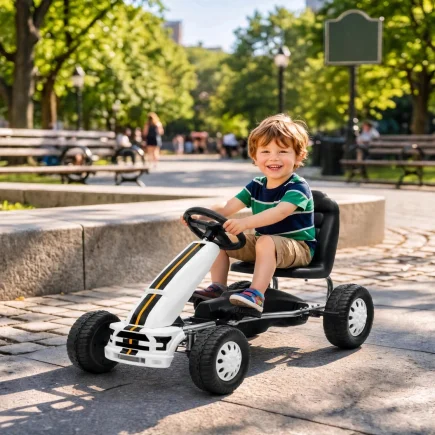

Charge the battery to the right level, disconnect it, store the kart somewhere cool, dry and indoors, and check the charge until spring. These six steps are for electric karts, because a pedal kart has no battery to look after.
1. Check the battery type: Lead-acid and lithium-ion batteries have different storage charge levels, so check the manual or battery label first.
2. Charge it: Charge a lead-acid battery completely before storage.[1] If a lithium-ion battery will sit for 30 days or longer, aim for roughly 40 percent.[2]
3. Switch off and disconnect: Store a lead-acid battery in the open-circuit condition, because a low drain over a long period can cause permanent damage.[1]
4. Store it cool, dry and indoors: Batteries should be stored cool, dry and upright, and Consumer Reports advises bringing them inside.[1][2]
5. Check it on a schedule: Check the voltage regularly and recharge as needed.[1]
6. Recharge before spring: Recharge to the level the manual gives before the first ride.
What Do You Need Before You Start?
- The manual or battery label: It gives the battery type and the maker’s storage advice.
- The kart’s own charger: Use it for every charge during storage.
- A voltmeter, if you have one: Penn State Extension advises checking voltage periodically.[3]
- A dry, cool spot indoors: Clear it before the kart goes in.
1. Check Which Battery Your Kart Has
Find the battery type on the label or in the manual, because lead-acid and lithium-ion batteries have different storage rules. Some product pages list it in the specifications, for example 12V 4.5Ah lead-acid. If a page gives only voltage and capacity, check the battery itself.
The sources in this guide cover batteries in general, not kids go kart batteries. Use them as general guidelines, and let the kart manual set the figures where it gives them.
2. Charge the Battery for Storage
Charge a lead-acid battery completely before it goes into storage.[1] Batteries also need to hold their charge through the storage period, which helps prevent freezing and damage over winter.[3]
- Lead-acid: Charge it completely after the last ride, using the charger that came with the kart.[1]
- Lithium-ion: If it will be 30 days or longer before the next use, aim for roughly 40 percent of capacity.[2] E-bike makers quoted by Consumer Reports give storage levels from 30 to 80 percent, so the maker’s figure takes priority.[4]
- After a cold ride: Let a lithium-ion battery come to room temperature indoors before charging it.[4]
3. Switch Off and Disconnect
Switch the kart off and disconnect the battery where the manual allows. Store a lead-acid battery in the open-circuit condition with the terminals insulated, because even a low drain over a long period can cause permanent damage.[1]
Clean corrosion and debris from the terminals and the top of the battery, which helps stop it discharging across the top.[3] Penn State Extension also advises disconnecting monitors and controllers to reduce parasitic draw, so unplug any add-ons the kart has.[3] If the battery is not made to come out, switch the kart off and store the whole kart.
4. Store It Somewhere Cool, Dry and Indoors
Pick a cool, dry spot indoors and keep the battery upright.[1][2]
- Temperature: Consumer Reports says lithium-ion tool batteries do best between 40°F and 80°F, so check the kart manual for its own range.[2] For lead-acid batteries, the DOE handbook advises cool, dry conditions.[1]
- Heat: High temperature is among the most detrimental conditions for a battery, particularly above 131°F (55°C).[1]
- Air: Consumer Reports advises storing e-bike batteries indoors in a dry, well-ventilated space.[4]
- Freezing: If a battery discharges too much, the acid inside may freeze, expand and damage the plates and casing.[3]
5. Check and Top Up on a Schedule
Check the charge on a schedule instead of waiting for spring. The DOE handbook says stored lead-acid batteries need regular voltage checks and a recharge as necessary or at regularly scheduled intervals.[1] Penn State Extension also advises checking voltage periodically.[3]
At each check, read the voltage if you have a meter, recharge if it is low, then disconnect the charger and store the battery again.
The manual sets the interval. If it gives none, check about once a month. One lithium-ion maker quoted by Consumer Reports advises a full charge every two months.[2]
Leave the kart charger connected only if the manual says it can stay connected. Penn State Extension mentions a small battery maintainer as another way to keep stored batteries at full voltage, so use one only if the manual allows it for your battery type.[3]
6. Recharge and Test Before the First Spring Ride
Recharge the battery to the level the manual gives, using the kart’s own charger, before the first ride. Then reconnect the battery and switch the kart on to check that it runs.
If the kart runs weak or will not hold a charge, contact the maker or seller.
Why Do These Six Steps Matter?
Each step answers a risk that battery guidance describes. These are general battery findings, not tests of kids go kart batteries.
| Topic | What the source says | Source |
| Sulfation | Self-discharge forms larger lead sulfate crystals that insulate the active material, which means lost capacity and higher internal resistance. | DOE handbook[1] |
| Freezing | A battery that discharges too much can freeze, expand and damage its plates and casing. | Penn State Extension[3] |
| Heat | High temperature speeds corrosion and self-discharge, particularly above 131°F (55°C). | DOE handbook[1] |
| Lithium-ion | Charge or discharge to roughly 40 percent for storage of 30 days or longer. | Consumer Reports[2] |
Worked Example: How Do Two Aosom Kart Pages Describe the Battery?
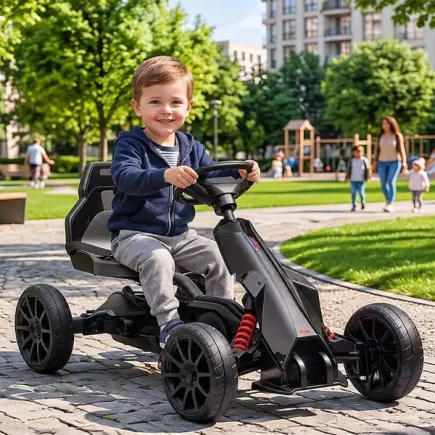
Two Aosom Electric Go Karts show how to find your battery type before storing. The Qaba 12V Electric Go Kart[5] names its battery type, and the Aosom 24V Electric Go Kart[6] gives voltage and capacity only.
| Feature | Qaba 12V Electric Go Kart | Aosom 24V Electric Go Kart |
| Battery | 12V 4.5Ah lead-acid | 24V, 5Ah, type not stated |
| Storage charge rule | Lead-acid rule applies | Check the manual or label first |
| Winter storage advice on page | Not given | Not given |
- What this shows: The battery type decides which charge level applies. For the 24V kart, the manual or battery label settles it.
- What to do: Read the manual, and ask the seller if it is silent on storage.
- Price and delivery (Qaba 12V Electric Go Kart): Priced at $136.99 at time of writing, with free standard delivery to U.S. addresses. Contact us within 30 calendar days of delivery to return it.
- Price and delivery (Aosom 24V Electric Go Kart): Priced at $279.99 at time of writing, with free standard delivery to U.S. addresses. Contact us within 30 calendar days of delivery to return it.
From Winter Storage to Spring Riding
To store a kids go kart over winter, check the battery type, charge it to the right level, disconnect it, keep it cool, dry and indoors, check it on a schedule and recharge it before the first spring ride.
A lead-acid battery goes into storage completely charged. A lithium-ion battery that will sit for 30 days or longer is stored at roughly 40 percent. These sources cover batteries in general, so the kart manual and battery label come first. If they are silent, ask the seller, and set a monthly reminder for the first check.
FAQs
Charge the battery to the level the manual gives, switch the kart off, disconnect the battery where allowed and store it somewhere cool, dry and indoors. Check the charge on a schedule until spring, then recharge before the first ride. The manual’s charge level and interval take priority over general guidance.[1][3]
Usually no. Leave the charger connected only if the manual says it can stay connected. Penn State Extension mentions a battery maintainer as one way to keep stored batteries charged, so use one only if the manual allows it. Otherwise, disconnect the charger and set a reminder to check the battery.[3]
Yes, if it is allowed to discharge too much. Penn State Extension says the acid inside may freeze, expand and damage the plates and casing.[3] Charge the battery before storage, and consider bringing it indoors, as Consumer Reports advises for tool batteries.[2]
About once a month unless the manual says otherwise. The DOE handbook says stored lead-acid batteries need regular voltage checks and a recharge as necessary or at regularly scheduled intervals.[1] One lithium-ion maker quoted by Consumer Reports advises a full charge every two months.[2]
Recharge it with the kart’s own charger. The DOE handbook says sulfation is normally reversible for lead sulfate still attached to the negative plate, by charging with a low current, but it does not cover kart chargers.[1] If the battery will not hold a charge, contact the maker or seller.
References
[1] Primer on Lead-Acid Storage Batteries (DOE-HDBK-1084-95) – U.S. Department of Energy.
https://www.energy.gov/documents/doe-hdbk-1084-95
[2] Why Your Electric Mower Needs Attention in Winter – Consumer Reports.
https://www.consumerreports.org/lawn-mowers-tractors/your-electric-mower-needs-attention-in-winter/
[3] Preparing and Storing Farm Equipment for Winter – Penn State Extension.
https://extension.psu.edu/preparing-and-storing-farm-equipment-for-winter
[4] How to Make Your Electric Bike Last Longer – Consumer Reports.
https://www.consumerreports.org/health/electric-bikes/how-to-make-your-e-bike-last-longer-a9368348989/
[5] Qaba 12V Electric Go Kart for Kids with Dual Motors, Adjustable Seat, Soft Start, LED Lights, EVA Wheels, for Age 3-6, Black | Aosom.
https://www.aosom.com/item/qaba-12v-electric-go-kart-for-kids-with-dual-motors-adjustable-seat-soft-start-led-lights-eva-wheels-for-age-3-6-black~27QQ2PEVC8001.html
[6] Aosom 24V 7.5 MPH Electric Go Kart with Adjustable Seat, Slow Start, Red | Aosom.
https://www.aosom.com/item/aosom-24v-7-5-mph-electric-go-kart-with-adjustable-seat-slow-start-red~1IDHEKJIK0O01.html