


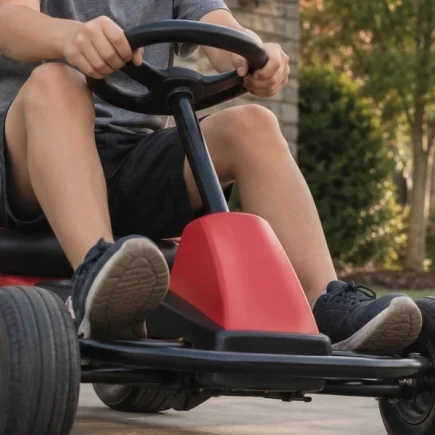
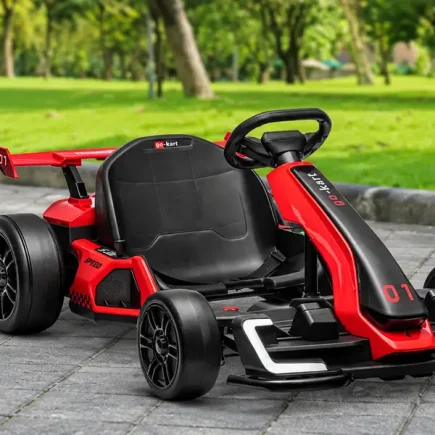







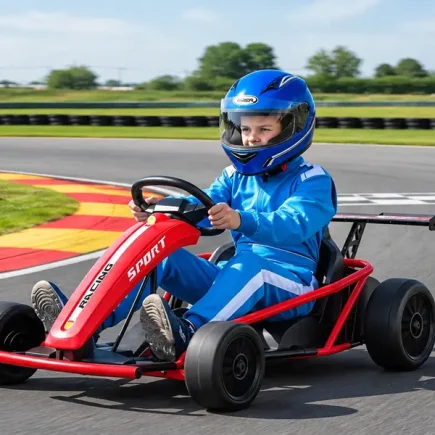
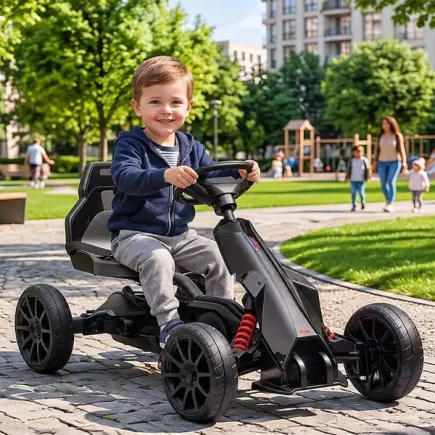

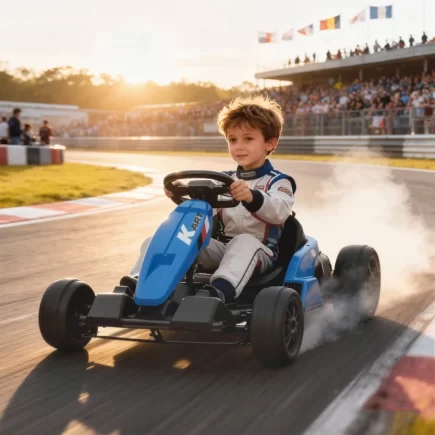
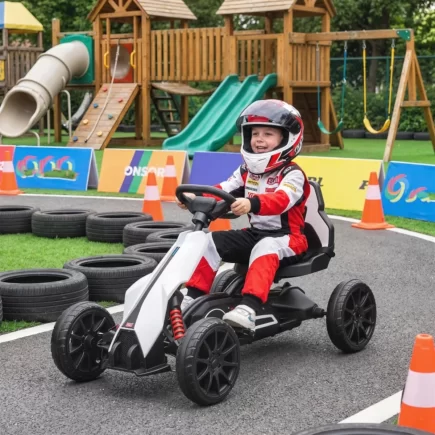
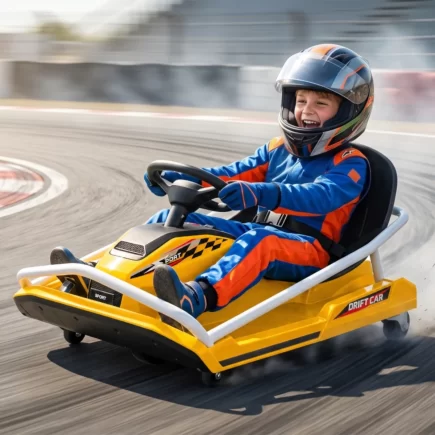
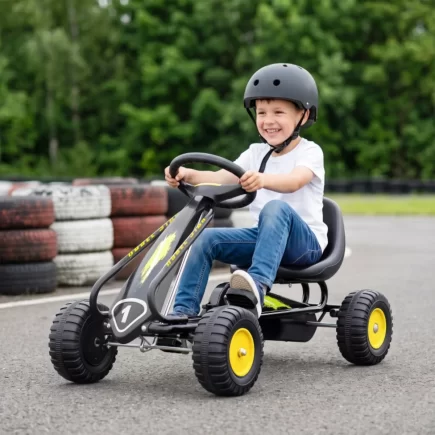

Not on a single-seat kart, which is how most kids go karts are built. Two children can only ride together on a model made as a two-seater, with a seat and a belt for each child and their combined weight inside the stated limit. On a kart built for one, such as the Aosom 24V adjustable-seat drift kart, the owner’s manual says to never allow more than one rider.[1] Three things decide this, and none of them bends when a second child climbs on.
- One seat, one restraint: Where a belt or harness is fitted, it holds one child in the seat, not two bodies sharing it.
- One rider’s weight: A 110 lb capacity describes a single seated rider, not the combined load of two children.
- No rated standing position: There is no footplate, handhold or belt on the rear of a kids kart, so a child standing there is outside anything the kart was built or tested for.
The Aosom 24V adjustable-seat kart is certified to ASTM F963 and CPSIA,[2] and ASTM F963 is the toy safety standard that federal law makes mandatory for children’s toys under 16 C.F.R. part 1250.[3] It includes stability and overload requirements for ride-on toys and toy seats.[4]
Why a Single-Seat Kart Has Room for Only One Rider
The single-rider limit is built into the frame, not a cautious note added at the end.
A single-seat kart’s steering, braking and center of gravity are all designed around one child seated in one position. Move or add weight, and each of those changes at the same time. A low, wide stance is what keeps a kart planted through a turn, so weight that sits high or off-center works directly against the shape that makes the kart stable in the first place.
The instructions follow the same logic. Aosom’s 24V kart manual asks parents to show children how to fasten the belt before riding,[1] a step written around one child in one seat. Pedal karts carry the same single-seat logic. An Aosom pedal kart rated to 66 lbs for ages 3 to 8 has one seat, and children should be monitored while they ride.[5]
What Does the Weight Limit on a Kids Go Kart Cover?
On a single-seat kart, one seated rider. It is not a combined allowance that two children can split between them.
This matters because the numbers run out faster than parents expect. Aosom’s US kart range spans several capacity tiers, and the figure that applies is the one printed for the model in front of you.
| Kart type | Typical age range | Stated weight capacity |
| Pedal kart, younger riders | 3 to 6 years | 77 lbs |
| Pedal kart, swing axle models | 3 to 8 years | 66 lbs |
| Pedal kart, older riders | 5 to 12 years | 110 lbs |
| 12V electric kart, younger riders | 3 to 8 years | 66 lbs |
| 12V electric drift kart | 8 to 12 years | 110 lbs |
| 24V drift kart, adjustable seat | 6 to 12 years | 110 lbs |
| 24V drift kart, two-speed | 8 to 12 years | 154 lbs |
The arithmetic is unforgiving. Two riders of 60 lbs each make 120 lbs, which is over a 110 lb kart’s limit even though neither child is close to it alone. On a 12V kart rated to 66 lbs, two riders of 35 lbs each are already over it. Exceeding the figure puts load on the frame, the axles and the braking that the kart was not specified to carry.
What Happens When a Second Child Climbs On
Children usually try one of three ways to fit a second rider, and each creates its own problem.
Standing on the back
A child standing behind the seat adds weight well above the axle line, which lifts the combined center of gravity of the kart and its riders. A higher center of gravity makes any vehicle easier to tip in a turn, and the standing child has nothing to hold and nothing to restrain them. A rear axle or bumper is a structural part, not a footplate rated to carry a person.
Sharing the seat
Two children wedged into one seat push the driver off-center and away from a square hold on the wheel. More importantly, one or both children end up with a poor line to the pedals. Aosom’s 24V adjustable-seat kart has a seat 15.75 inches wide,[2] which is sized for one child and leaves no room for two.
Riding on the driver’s lap
A child on the driver’s lap blocks the driver’s view of what is immediately ahead and sits between the driver and the steering wheel. In a sudden stop, the front child has no restraint, and the driver’s belt does nothing to hold them.
How to Check What Your Kart Is Rated For
The rider count and weight limit are set out in the manual and the product specifications, so check them before a second child asks for a turn.
- The owner’s manual: Where a rider limit is stated, it sits in the warning block near the front, next to the age range and the maximum user weight.
- The product listing specifications: Weight capacity and recommended age sit in the spec list, often alongside seat dimensions.
- The label on the kart: Some karts also carry a label with the age and weight limits on the frame or under the seat, so check for one.
- Seat width against your child: A seat that fits one child snugly has no room for a second, whatever the weight figures suggest.
- Belt count: One belt means one rider. Two seats with a belt each is a different product class.
If the manual, the listing and the label give different figures, contact the retailer to confirm before the first ride.
What Can Two Children Do Instead of Sharing One Kart?
There are three workable answers, and which one fits depends on the age gap and the space available.
- Take turns on a timer: A set number of laps or minutes each settles the argument that makes children improvise in the first place.
- Match each child to a kart that fits them: Two children at different ages rarely suit the same kart anyway. A 12V kart for a younger child and a 24V kart for an older one gives each a model inside its own age and weight band.
- Choose a ride-on built for two: A two-seat ride-on has a seat and a belt for each child and a capacity figure set for both, which is a different thing from stretching a single-seat kart.
That last option is worth understanding properly, because a two-seat rating is not a license to ignore the weight limit. The combined figure still applies. Aosom’s two-seat ride-on truck has a 110 lb weight capacity and is recommended for ages 3 to 5.[6]
Comparing a Single-Seat Kart With a Two-Seat Ride-On
A single-seat kart and a two-seat ride-on are specified very differently. These are examples of what to look for, not recommendations.
| Feature | Single-seat kart[5] | Two-seat ride-on[6] |
| Name of product | Aosom 24V 7.5 MPH Electric Go Kart with Adjustable Seat | Aosom 12V Kids Electric 2-Seater Ride On Police Car SUV Truck |
| Seating capacity | 1 | 2 |
| Weight capacity | 110 lbs | 110 lbs |
| Age range | 6 to 12 years | 3 to 5 years recommended |
| Restraint | Seat belt | A belt for each seat |
| Certification | ASTM F963, CPSIA | ASTM F963, CPSIA |
The two products quote the same 110 lbs, but one spreads it across two seated children recommended at ages 3 to 5 and the other gives the whole figure to a single rider aged 6 to 12.[2][6] In this pair, the second seat changes how the load is shared and restrained, not how much the vehicle can carry.
The two-seat example here is a ride-on truck rather than a kart, so for a kart shape, the usual choice is between taking turns and a second kart.
Common Mistakes Parents Make With Rider Limits
These come up often enough to be worth naming.
- Reading the weight capacity as a combined family allowance rather than a single-rider figure.
- Assuming a higher-capacity drift kart has room for a passenger, when the extra capacity is there for a heavier single rider.
- Treating an adjustable seat as extra space. Seat adjustment moves the seat closer to or further from the pedals, and does not widen it.
- Allowing a short ride at low speed with two children, on the basis that a slow kart is a forgiving one. A raised center of gravity makes a kart easier to tip in a turn, even at low speed.
- Letting an older sibling stand on the back to steady a nervous younger driver. Supervision belongs beside the kart, not on it.
Choosing Between One Kart and Two
A single-seat kart carries one child. That is settled by the seat, the belt and the weight rating together, and the manufacturer’s own instruction to allow no more than one rider leaves no room to read it another way. Where two children both want to ride, the realistic choices are turn-taking with a timer, a second kart matched to the other child’s age and size, or a ride-on specified for two seats from the outset. Before buying anything, check the weight capacity, the seating capacity and the seat dimensions on the listing, then check them again in the manual before the first ride.
For help matching a kart to one child’s age and size, see the How to Choose a Go Kart guide, or browse the full Kids Go Karts range.
FAQs
Many do, but it depends on the model. The 24V adjustable-seat kart, for example, comes with a seat belt.[1] On any powered kart, check for a belt or harness before the first ride.
No. The weight capacity on an Aosom listing is the rider limit, and the kart’s own weight appears separately as the item weight.[2] A 110 lb capacity means 110 lbs of child, not 110 lbs of child and kart together.
No. A kart is certified in the configuration it is sold in, and ASTM F963 is mandatory for children’s toys in the United States.[3] Bolting on a seat, a board or a footplate puts the kart outside what it was tested as, and the one-rider instruction in the manual still stands.[1]
There isn’t one. The 24V kart’s manual requires adult supervision and says a child should never be left unattended.[1] The age range on a listing describes who the kart fits, not the point at which supervision stops.
The 24V adjustable-seat model is recommended for ages 6 to 12, and its seat adjusts between 20.75 and 26.5 inches.[2] Once the seat sits at its furthest setting and the child is still cramped, the kart has run out of adjustment, whatever the scales say.
References
[1] Aosom, Owner’s Manual, 24V Electric Drift Go Kart with Adjustable Seat.
https://scm-manual.aosomcdn.com/fileserver/as/1315293657774949376/202403/1915269227889471488/98b47c12a3cb4a27bb82b79dcc696885/IN230700076V02_US_CA_370-287V80.pdf
[2] Aosom, Aosom 24V 7.5 MPH Electric Go Kart with Adjustable Seat, Slow Start, Red.
https://www.aosom.com/item/aosom-24v-7-5-mph-electric-go-kart-with-adjustable-seat-slow-start-red~1IDHEKJIK0O01.html
[3] U.S. Consumer Product Safety Commission, Toy Safety Business Guidance.
https://www.cpsc.gov/toysafety
[4] ASTM International, ASTM F963-23 Standard Consumer Safety Specification for Toy Safety.
https://store.astm.org/f0963-23.html
[5] Aosom, Aosom Kids Pedal Go Kart with Swing Axle and Shock-Absorbing Wheels, Red.
https://aosom.com/item/aosom-kids-pedal-go-kart-w-swing-axle-shock-absorbing-wheels-red~1IF4UP03C6G01.html
[6] Aosom, Aosom 12V Kids Electric 2-Seater Ride On Police Car SUV Truck with Parental Remote Control.
https://www.aosom.com/item/aosom-kids-12v-rc-2-seater-ride-on-police-truck-led-lights-mp3-yellow~370-082YL.html