


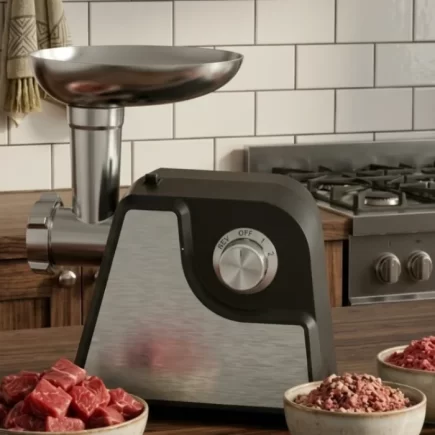
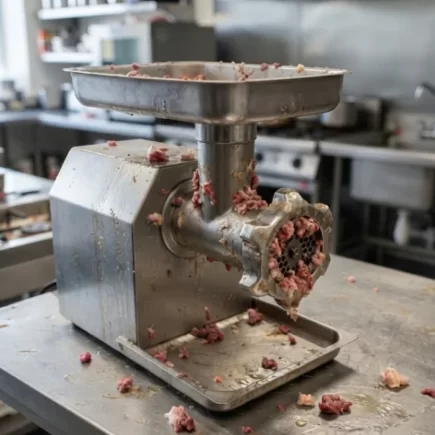

























A meat grinder turns larger pieces of meat into smaller, evenly sized portions by combining feeding, cutting and extrusion. As meat enters the machine, a rotating auger moves it towards a cutting blade and perforated plate. The blade cuts the meat, while the plate controls the size and texture of the finished mince.
Manual grinders rely on a hand crank, whereas electric models use a motor to maintain continuous movement. Understanding this process makes it easier to use a grinder correctly, identify common problems and choose a model that suits your cooking needs.
What a Meat Grinder Actually Does
At its core, a meat grinder is a mechanical tool that processes whole cuts into smaller, consistent pieces. Rather than chopping meat manually, it moves the meat through a controlled path and produces a predictable texture.
This is particularly useful when preparing burgers, meatballs, sausages and other recipes where the size and distribution of the meat can affect the final result. The ability to select different grinding plates also allows the texture to be adjusted for different recipes.
The Main Parts of a Meat Grinder Explained
Most meat grinders use the same fundamental components, although their size, design and construction can vary.
| Part | Function |
| Hopper | Holds the meat before it enters the feed tube. |
| Feed tube | Directs meat towards the auger. |
| Auger (worm screw) | Moves and compresses meat towards the cutting assembly. |
| Cutting blade | Cuts meat as it moves across the grinding plate. |
| Grinding plate | Determines the size and texture of the finished mince. |
| Motor or hand crank | Provides the force needed to rotate the auger. |
| Pusher | Guides meat into the feed tube safely. |
| Blade and plate cover | Encloses the cutting assembly during operation. |
The Sausage Maker’s material on meat grinders also identifies the auger, knife and plate as the main components involved in the grinding process. A cover around the cutting assembly helps keep the operating area contained while meat is being fed through the machine.
Step-by-Step: What Happens When You Feed Meat Through
Although the process happens continuously, each stage has a specific purpose.
- Meat is cut into manageable pieces that can enter the hopper.
- The pieces are placed into the hopper above the feed tube.
- The rotating auger catches the meat and moves it forwards.
- The meat becomes compressed as it approaches the cutting assembly.
- The blade cuts the meat against the stationary plate.
- The processed meat is forced through the plate openings.
- The finished mince exits the front of the grinder.
The consistency of this process depends on several factors, including meat temperature, blade condition, plate selection and the amount being fed into the machine at one time.
How the Auger Pushes Meat Forward
The auger is a spiral-shaped component positioned inside the grinder housing. Its flights catch the meat and carry it towards the blade and plate as it rotates.
Its role is not limited to transporting the meat. The rotating screw also creates pressure as the meat moves through the narrower section of the housing. This pressure helps the meat reach the cutting assembly and pass through the plate.
A steady feed generally produces better results than forcing a large quantity into the hopper at once. Cutting meat into appropriately sized pieces before grinding can also reduce unnecessary strain on the mechanism.
How the Blade and Plate Work Together to Cut Meat
The blade and grinding plate form the main cutting system. The plate remains stationary while the blade rotates against its surface.
As the auger pushes meat towards this point, the blade shears it against the plate. The cut pieces then pass through the plate openings and emerge from the other side.
This relationship is important because the condition and positioning of both components matter. A sharp blade with proper contact against the plate can produce cleaner cuts, while a damaged or poorly fitted cutting set may cause meat to smear instead of being cut efficiently.
Manual and Electric Grinders: How the Mechanism Differs
Manual and electric grinders use the same basic processing principle, but the source of their power is different.
- Manual grinders use a hand crank to rotate the auger. The operator controls the pace directly but must provide continuous physical effort.
- Electric grinders use a motor to rotate the auger, reducing the physical work required from the user.
- Electric models can be more convenient when processing larger quantities because the operator does not need to turn a crank throughout the process.
- Manual grinders generally have a simpler drive system and do not require an electrical power source.
The better choice depends on how frequently the grinder will be used, how much meat is normally processed and how much physical effort the user is comfortable providing.
Standalone Grinders and Stand Mixer Attachments: How They Work
A standalone grinder has its own drive system. Depending on the design, this may be an electric motor or a manual crank.
A stand mixer attachment does not contain its own motor. Instead, it connects to a compatible stand mixer’s power hub and uses the mixer’s motor to operate the grinding mechanism.
The basic internal process remains similar in both cases. Meat is moved towards the cutting assembly and processed through the selected plate. The main difference is the source of the rotational power.
For occasional grinding, an attachment can make use of equipment that is already available. A standalone grinder may be more appropriate for people who process meat regularly and want dedicated equipment.
Why Meat Should Be Cold Before Grinding
Meat temperature affects both the grinding process and food safety. When fat becomes too warm, it softens and can smear across the blade and plate rather than being cut cleanly. This may clog the plate openings and result in a sticky or paste-like texture.
There is also an important food-safety reason to control temperature. The USDA Food Safety and Inspection Service explains that grinding increases the amount of meat surface exposed and can distribute bacteria throughout the product. USDA FSIS also identifies 40°F to 140°F as the temperature range in which bacteria can multiply rapidly.
Keeping meat properly chilled during preparation helps maintain firmer fat and supports cleaner grinding. Chilling the removable grinder components before use can also help keep the meat cold during processing.
Understanding Plate Hole Sizes and Grind Texture
The grinding plate has a major influence on the final texture. Its openings determine the approximate size of the pieces that pass through the grinder.
| Plate size | Resulting texture | Typical uses |
| Large holes | Coarse | Chilli, chunky burgers and coarse sausage. |
| Medium holes | Medium | Burgers, meatballs and general-purpose mince. |
| Small holes | Fine | Fine sausage mixtures and smoother preparations. |
The exact hole diameter varies between manufacturers and models, so descriptions such as “fine” or “coarse” should not be assumed to mean the same size across every grinder.
Using the correct plate allows the same grinder to produce different textures without changing the basic mechanism.
Single Grind and Double Grind: What’s the Difference?
A single grind means the meat passes through the grinder once. This usually preserves a more noticeable texture because the meat undergoes only one cutting cycle.
A double grind sends the meat through the machine for a second time. The second pass is often performed with a smaller-hole plate to create a finer and more uniform result.
The appropriate method depends on the recipe. A coarse single grind can work well when a distinct meat texture is desirable, while a second pass can be useful for preparations that require finer particles and more even fat distribution.
What Happens Inside the Motor Housing on Electric Models
An electric grinder contains a motor and transmission components that transfer power to the auger. The motor may rotate at a higher speed than is suitable for directly driving the grinding mechanism, so gearing can be used to provide the required combination of speed and torque.
Torque is particularly important because the auger needs enough turning force to move dense meat through the cutting assembly.
This means the motor’s wattage should not be considered the only indicator of performance. The design of the motor, gearing, blade, plate and overall grinder can all influence how effectively the available power is used.
Safety Features Built Into How Grinders Operate
Safe operation depends on keeping hands away from the feed path and cutting assembly.
The pusher allows meat to be guided into the feed tube without placing fingers close to the auger. Many electric grinders also include a reverse function, which can temporarily change the auger’s direction to help release material when the mechanism becomes blocked.
Some models have covers around the blade and plate area to provide additional separation from moving components.
If a grinder becomes jammed, follow the manufacturer’s instructions. For electric models, switch off and unplug the machine before attempting to disassemble or manually clear the blockage unless the manufacturer’s instructions specify another procedure.
How Grinder Power and Wattage Affect Performance
Wattage can provide an indication of the electrical power associated with an electric grinder, but it does not tell the complete story about grinding performance.
A higher-rated motor may be better suited to demanding workloads, but the actual result depends on the entire drive system. Gear reduction, motor efficiency, blade sharpness, meat temperature and the amount of meat being processed can all affect performance.
Instead of comparing wattage alone, consider the type and quantity of meat you normally grind. Someone processing small batches occasionally has different requirements from a user preparing large quantities regularly.
Signs the Grinder Is Working Correctly
A properly functioning grinder should produce a relatively steady flow of meat with a texture that matches the selected plate.
Several changes can indicate that something needs attention:
- Mushy or paste-like meat: The meat may be too warm, or the blade may be dull.
- Slow or interrupted feeding: The feed tube may be overloaded or blocked.
- Repeated stalling: The load may be too demanding for the grinder.
- Excessive smearing: Soft fat may be coating the blade or plate.
- Unusual noise or vibration: The cutting assembly or another component may not be correctly positioned.
Not every performance issue indicates motor failure. Checking the meat temperature, blade, plate and assembly can help identify simpler causes first.
What Causes a Meat Grinder to Jam?
A grinder can jam when the material entering the cutting assembly cannot move through it efficiently.
Long strands of connective tissue can wrap around the blade or auger, while oversized pieces of meat or an overloaded hopper can restrict movement. Soft, warm fat can also accumulate around the plate openings.
Some electric grinders provide a reverse setting to help release material. This should be used according to the manufacturer’s instructions rather than repeatedly forcing the grinder through a blockage.
If reversing does not resolve the problem, turn the machine off and disconnect the power before inspecting the components.
What This Mechanism Means for Choosing the Right Grinder
Knowing how a grinder works makes product specifications easier to evaluate.
- Plate options matter when different textures are required. A grinder with several plate sizes offers greater flexibility than one with only a single option.
- Motor and drive design become more important when processing larger quantities or tougher cuts. However, wattage alone should not determine the choice.
- Manual versus electric operation is primarily a question of effort, batch size and frequency of use.
- Standalone versus attachment models depends on whether dedicated equipment is worthwhile or an existing stand mixer can handle the task.
- Cleaning and maintenance should also be considered because the blade, plate and grinding head come into direct contact with food.
Who This Matters Most For
Understanding the grinding mechanism is particularly useful for people who want to use or purchase a grinder with confidence.
- First-time buyers comparing manual and electric models.
- New owners learning how to prepare meat and use different plates.
- Home cooks making burgers, meatballs or sausages from whole cuts.
- Hunters and bulk processors handling larger quantities of meat.
- Users troubleshooting problems such as jamming, smearing or inconsistent texture.
Who May Not Need a Meat Grinder?
A dedicated grinder may not be necessary for someone who only occasionally needs minced meat and has no interest in controlling the grind size.
For infrequent use, a compatible stand mixer attachment may also be a practical alternative when the necessary mixer is already available.
Key Takeaways
A Meat Grinder uses a straightforward sequence: the auger moves the meat, the blade cuts it, and the grinding plate controls the resulting texture.
Meat temperature, blade condition, plate selection and feeding technique all influence the final result. Manual and electric grinders follow the same fundamental process, but their different power sources make them suitable for different workloads.
Understanding these components can help users operate a grinder more safely, troubleshoot common problems and focus on the specifications that actually matter when choosing one.
FAQs
A meat grinder uses an auger to feed meat into a rotating blade and fixed plate, extruding it through holes for a uniform mince. A food processor uses fast-spinning blades to randomly chop, which bruises meat and creates an uneven, inconsistent texture.
The auger compresses meat to create steady pressure toward the cutting assembly. This keeps meat in constant contact with the blade and plate, prevents air pockets, ensures continuous feeding, and helps produce an even, consistent flow of minced meat.
After being cut against the plate, meat is pushed through the plate openings by the auger’s continuous pressure. It then exits the front of the grinder as minced meat, with its final texture and coarseness determined by the size of holes in the plate.