


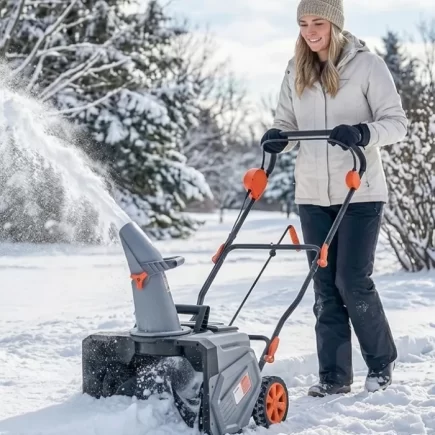











Choosing the right snow blower can make winter snow clearing faster, easier, and less demanding. The best choice depends on the amount and type of snow you receive, the size of your property, and the surfaces you need to clear. Different snow blowers also vary in power, size, operation, and features. Understanding these differences helps you choose a machine that fits your home and regular winter conditions.
Quick-Glance Buying Summary
| Factor | What to Look For |
| Snow depth | Rated clearing depth of 10 to 12 inches. |
| Type | Single-stage for paved areas, decks, and walkways. |
| Power source | Cordless 40V system with a brushless motor. |
| Clearing width | 18 inches for a balance of coverage and control. |
| Auger | Polyurethane or rubber to protect surfaces. |
| Chute | 180-degree rotation with adjustable pitch. |
| Throwing distance | 20 feet or more. |
| Battery | Two batteries and a fast charger. |
| Safety | Dual-action, two-hand start switch. |
1. Assess Your Snowfall and Clearing Conditions
Typical Snowfall and Snow Depth
Choose a snow blower based on the snowfall your area typically receives and the conditions you expect to encounter. The right intake height depends on the machine’s design, snow depth, and snow density. If your driveway regularly collects deep snow or compacted drifts, consider a model with greater clearing capacity. Paying for capacity you rarely need may add unnecessary weight and cost.
| Typical Snow Depth | General Recommendation |
| Light to moderate snowfall | A suitable single-stage model may be sufficient. |
| Deeper accumulation | Consider a model with greater intake capacity. |
| Deep, heavy, or compacted snow | A suitable two-stage or higher-capacity model may be more appropriate. |
These are general guidelines rather than fixed rules. Check the manufacturer’s rated intake height and intended operating conditions before buying.
Wet, Powdery, and Packed Snow
Powdery snow is generally easier to move than wet, heavy snow, which places greater demands on a snow blower’s motor and auger. Brushless motors can reduce friction-related wear and improve efficiency, but motor wattage alone does not determine clearing performance. Consider the motor’s rated output, auger design, intake capacity, and the manufacturer’s guidance when comparing models for different snow conditions.
- Powdery snow: Generally easier to collect and discharge.
- Wet snow: Heavier and more demanding on the motor and clearing mechanism.
- Packed snow: May require greater clearing capacity and a suitable auger design.
Plow Piles and Heavy Drifts
Compacted plow piles at the end of a driveway can be particularly difficult to clear because they may contain dense snow and ice. Clearing them promptly, where practical, can be easier than allowing them to harden. If your property regularly experiences deep drifts or heavy plow piles, choose a machine designed for those conditions rather than relying on a light-duty model to handle every snowfall.
2. Consider Your Driveway and Property
Driveway Size and Clearing Area
Measure the entire area you need to clear, including the driveway, walkways, entrances, and other accessible surfaces. Clearing width affects how many passes you need, while the machine’s size and weight influence how easily you can manoeuvre it. A narrower model may suit small driveways and tight paths, whereas a wider model can reduce the number of passes across larger areas. Choose a width that balances coverage with convenient handling and storage.
Consider the following before choosing a model:
- Main driveway length and width.
- Walkways and paths.
- Steps and entrances.
- Patio or deck areas.
- Distance snow needs to be thrown.
- Available storage space.
Paved, Gravel, and Uneven Surfaces
The surface beneath the snow affects which snow blower is suitable for your property. Some rubber-edged or polymer augers are designed to reduce contact damage, but their suitability depends on the machine and the surface being cleared.
Before using a snow blower on wood, composite decking, gravel, or sealed paving, check the manufacturer’s instructions to confirm that the model is appropriate for that surface.
Walkways, Steps, Decks, and Other Areas
Smaller clearing areas often benefit from a machine that is easy to steer and position. A lighter cordless model may be convenient for narrow paths and tight spaces, but its suitability depends on the surface, snow conditions, and manufacturer’s instructions. Consider how easily you can manoeuvre the machine around corners and obstacles, as well as whether you can transport and store it comfortably.
3. Choose the Right Snow Blower Type
Single-Stage Snow Blowers
Single-stage models use one auger to collect snow and direct it through the discharge chute. They are generally lighter, more compact, and easier to store than larger machines. They are typically suited to light or moderate snowfall on compatible paved surfaces. Their suitability for decks and other delicate surfaces varies by model, so check the manufacturer’s instructions before use.
Two-Stage Snow Blowers
Two-stage models use an auger to collect and break up snow before an impeller moves it through the discharge chute. This design is generally better suited to deeper, heavier, and more compacted snow. Many models are self-propelled, making them easier to move across larger areas, although they are usually heavier and require more storage space than single-stage machines.
Three-Stage Snow Blowers
Three-stage models add an accelerator to help move snow through the machine. They are designed for demanding clearing conditions and can suit properties that regularly experience deep accumulation and heavy snow. However, their additional capacity may be unnecessary for smaller properties with relatively light snowfall. Compare the machine’s rated performance, size, and price with your actual clearing needs.
| Type | Best For | Limitations |
| Single-stage | Light to moderate snow, paved areas, decks. | Less suited to very deep snow. |
| Two-stage | Deep, heavy snow. | Larger, heavier, more expensive. |
| Three-stage | Extreme snow conditions. | Often unnecessary. |
4. Choose Between Gas, Corded, and Battery Power
Gas Snow Blowers
Gas models are available in configurations designed for extended operation and demanding clearing conditions. They can suit larger properties, particularly where access to electrical power is limited. However, they require fuel, engine maintenance, and seasonal servicing. They are also generally louder and heavier than electric alternatives, so consider whether their additional capacity justifies the extra upkeep.
Corded Electric Snow Blowers
Corded models start quickly and typically require less maintenance than gas-powered machines. They can suit smaller clearing areas close to a suitable outdoor power outlet. However, the cord limits working range and needs careful management around obstacles, vehicles, and the machine itself. Check the manufacturer’s instructions for safe outdoor electrical use.
Cordless Battery Snow Blowers
Cordless models offer electric operation without a power cord, making them convenient for areas where mobility matters. Their performance depends on battery capacity, motor design, auger construction, and snow conditions. Compare the manufacturer’s specifications for clearing capacity and expected runtime to determine whether a cordless model can handle your property and typical snowfall.
| Feature | Gas | Corded Electric | Cordless Battery |
| Power | High | Moderate | Moderate to strong. |
| Runtime | Fuel-dependent | Continuous | Battery-dependent. |
| Noise | Higher | Lower | Lower |
| Maintenance | Higher | Low | Low |
| Mobility | High | Limited by cord | High |
5. Check the Key Specifications
1) Clearing Width and Intake Height
Clearing width determines how much snow the machine collects per pass, while intake height indicates the depth it is designed to handle. A wider intake can reduce the number of passes but may increase the machine’s size and weight. Compare both measurements with your driveway dimensions, available storage space, and typical snowfall. Actual clearing performance also depends on snow density and machine design.
- 18 to 21 inches: May suit smaller driveways, walkways, and compact clearing areas.
- 22 to 24 inches: Can offer a balance between coverage and manoeuvrability.
- 24 inches or wider: May suit larger clearing areas where additional coverage is useful.
These ranges are comparison points rather than universal recommendations. Choose according to the manufacturer’s specifications and your property’s layout.
2) Motor Power
Compare motor type and rated output alongside the machine’s clearing width, intake height, and intended use. Wattage alone does not establish how effectively a snow blower handles heavy snow, how quietly it operates, or how long it will last. Brushless motors generally reduce friction-related wear, but overall performance and durability depend on the complete design and maintenance requirements.
3) Auger Type and Surface Protection
The auger collects and moves snow towards the discharge chute. Different materials and designs suit different clearing conditions and surfaces. Some rubber-edged or polymer augers are designed to reduce contact damage, while other designs may be intended for more demanding snow conditions. Check the manufacturer’s surface compatibility guidance before choosing a model for decks, gravel, paved areas, or sealed driveways.
4) Chute Control and Throwing Distance
The discharge chute directs snow away from the cleared area. Look for convenient directional controls and adjustable pitch so you can manage where the snow lands. A chute with a wide range of movement can help direct snow away from cars, entrances, windows, and walkways. Consider the stated throwing distance, but remember that actual performance varies with snow density, wind, and machine design.
6. Consider Battery Runtime and Charging
Battery Runtime in Real Conditions
Runtime depends on battery capacity, temperature, snow depth, snow type, and clearing speed. Wet, heavy snow can consume more battery power than light powder, while cold temperatures may reduce available performance. Check the manufacturer’s expected runtime and compare it with the time you need to clear your property.
Charging Time and Spare Batteries
Check whether the charger and additional batteries are included in the package. A second compatible battery can extend your clearing time, but the benefit depends on whether the machine uses batteries sequentially or simultaneously and how quickly the batteries recharge. Compare battery capacity, charging time, and package contents before purchasing additional accessories.
Cold-Weather Battery Performance
Cold temperatures can reduce battery performance, particularly when batteries are stored or charged outside the manufacturer’s recommended temperature range. Follow the instructions for operating, charging, and storing batteries. Bring removable batteries indoors when appropriate, and allow them to reach the recommended charging temperature before connecting them to a charger. Proper storage and charging practices help maintain battery performance over time.
7. Think About Handling, Safety, and Storage
Weight and Maneuverability
The weight of a snow blower affects how easily you turn, push, transport, and store it. Larger machines may offer greater clearing capacity but can be more difficult to manoeuvre around tight paths and obstacles. Choose a model that the intended operator can handle comfortably throughout the job. Consider handle design, wheel configuration, storage dimensions, and whether the machine is self-propelled.
Safety Features
Snow blowers throw snow, ice, and debris at speed, so safety features matter on every model. Look for a dual-action safety switch that requires two-handed operation to start. This design prevents accidental startups, which is especially important in homes with children and pets. It also reduces the risk of the machine starting while you clear a blockage.
- Turn the machine off before clearing a blockage.
- Never put your hands inside the chute.
- Use the recommended clearing tool for clogs.
- Keep children and pets away from the work area.
- Wear sturdy, slip-resistant footwear.
- Follow the manufacturer’s instructions.
Cleaning and Storage
Remove accumulated snow and moisture after use according to the manufacturer’s instructions. Check the machine for damage, loose parts, or obstructions before storing it. Keep the snow blower in a dry, protected location, and store removable batteries according to the manufacturer’s temperature and charging guidance. Gas-powered models may require additional preparation before seasonal storage, while electric models generally avoid fuel-related maintenance.
8. Snow Blower Price and Long-Term Value
The purchase price is only one part of the total cost of owning a snow blower. Gas-powered models require fuel and engine maintenance, while electric models use electricity and generally need less routine upkeep. Battery-powered models may also require replacement batteries over time. Compare the expected maintenance, replacement parts, and accessories alongside the initial price to understand the long-term cost.
| Cost Factor | Gas | Corded Electric | Cordless Battery |
| Fuel or power | Fuel and oil | Electricity | Electricity |
| Engine maintenance | Required | Minimal | Minimal |
| Battery replacement | No | No | Possible |
| Long-term upkeep | Higher | Low | Low |
A package that includes two batteries and a charger avoids extra accessory costs after purchase. That improves overall value, especially for properties that need more than one charge to finish. Compare the full package price rather than the machine alone. This gives a more accurate picture of what you actually pay to get started.
Avoid Common Snow Blower Buying Mistakes
- Buying more size and weight than your typical snowfall requires.
- Ignoring surface compatibility, particularly for wood decking, composite materials, or gravel.
- Comparing motor wattage without considering the complete machine design.
- Choosing a battery model without checking runtime and charging time.
- Overlooking storage space and manoeuvrability.
- Comparing only the purchase price instead of maintenance and replacement costs.
- Assuming a snow blower can handle every type of snow or surface without checking the manual.
Winter preparation becomes much easier when you have the right equipment ready before the first snowfall. Choosing a snow blower that fits your property, storage space, and budget can make snowy mornings less stressful. By choosing the right Snow Blower model for your needs, you can keep outdoor areas accessible and make winter snow clearing more manageable.
FAQs
The terms are often used interchangeably for machines that remove snow from driveways and paths. In practice, both can refer to single-stage, two-stage, or larger snow-clearing machines, depending on the manufacturer.
Yes, a snow blower can be used at night if the area is well lit and the conditions are safe. Models with built-in headlights can improve visibility, but you should still make sure the driveway and surrounding area are clearly visible. Avoid clearing during severe weather or poor visibility.
Some snow blowers may move small amounts of loose debris, but they are not designed for clearing leaves. Leaves, sticks, and other debris can clog or damage components. It is better to remove larger debris from the clearing area before operating the machine.
Service requirements depend on the type of snow blower and how frequently it is used. Gas models generally need more regular engine maintenance, while electric models require fewer mechanical checks. Always follow the manufacturer’s maintenance schedule for inspections and replacement parts.