


























You can fix many common hand blender problems at home by checking the power connection, attachment, blade and signs of overheating. Loose shafts, blocked blades and thick mixtures are often simple to resolve, while damaged cords, burning smells or liquid inside the motor require professional attention or replacement. Always unplug the blender before checking or cleaning any part.
Quick Answer: What Is Wrong With My Hand Blender?
| Hand Blender Problem | Most Likely Cause | What to Do |
| Won’t turn on | No power, loose shaft or safety lock | Check the socket, cord and shaft connection. |
| Stops during blending | Overheating or overload | Unplug it and let it cool for 20–30 minutes. |
| Motor runs but blade does not spin | Worn coupling or loose shaft | Refit the shaft or replace the worn part. |
| Blending is weak | Dull blade or thick mixture | Cut ingredients smaller and add liquid. |
| Food splashes | Blade too close to surface or wide container | Use a tall, narrow jug and start slowly. |
| Grinding or rattling | Debris, loose blade or worn bearing | Stop using it, clean and check the attachment. |
| Burning smell | Overheated motor or wiring | Unplug immediately and do not continue using it. |
| Liquid enters motor unit | Failed seal or submersion | Stop using the blender and have it serviced or replaced. |
| Buttons do not respond | Moisture, residue or worn switch | Unplug, dry thoroughly and test again. |
What Should You Check Before Fixing a Hand Blender?
Before assuming the motor has failed, unplug the hand blender and inspect its basic components. Loose attachments, blocked blades and power problems are often easier to resolve than an internal motor fault.
- Test the wall socket with another appliance.
- Inspect the cord for cuts, kinks or exposed wires.
- Check the blending shaft for cracks or food around the blade.
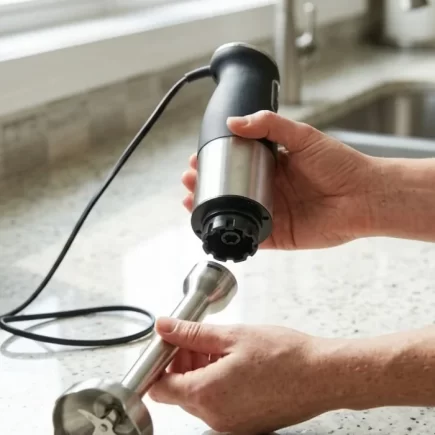
- Make sure the shaft clicks securely into the motor unit.
- Check the manufacturer’s manual for the maximum continuous running time.
If the basic checks do not identify the problem, avoid opening the motor housing. Internal electrical components are not generally suitable for DIY repair.
Why Won’t My Hand Blender Turn On?
A hand blender that does not start usually has a power supply problem, an incorrectly fitted shaft, a safety lock issue or a failed switch. Checking these points first can help identify whether the fault is simple or internal.
- No power: Test the socket with another appliance and reset a tripped breaker.
- Plug fuse: Replace a blown fuse with one of the same rating.
- Loose shaft: Make sure the shaft is fully seated and locked.
- Damaged cord: Do not tape or repair a damaged power cord; replace the blender.
- Failed switch or motor: If the power and attachment checks pass, an internal component may have failed.
If the blender remains completely unresponsive after these checks, replacing the unit may be more practical than attempting an internal electrical repair.
Why Does a Hand Blender Stop Mid-Use?
A hand blender commonly stops during use because its motor overheats and the thermal cut-out switches it off. Thick mixtures, large quantities and prolonged operation can put additional load on the motor.
To reset and prevent the problem:
- Unplug the blender and allow it to cool for 20–30 minutes.
- Blend in short 30–60 second bursts, following the duty cycle in the manual.
- Cut hard or fibrous ingredients into smaller pieces.
- Add liquid when the mixture is too thick.
- Remove food that has become trapped around the blade.
If the blender repeatedly cuts out during light tasks, the motor or thermal protection may be wearing out. Continued use may make the fault worse.
How Do You Fix a Hand Blender When the Motor Runs but the Blade Does Not Spin?
If the motor runs but the blade stays still, the drive connection between the motor and shaft may have slipped or worn. The motor itself can still be working normally.
Follow these checks:
- Unplug the blender and remove the shaft.
- Inspect the shaft end and motor drive socket for chipped or rounded teeth.
- Check the blade area for trapped food or debris.
- Refit the shaft securely.
- Test the blender with the blade in water.
- Replace the shaft or coupling if the drive teeth are worn.
A plastic coupling is a common wear component and can often be replaced relatively cheaply. If the metal drive inside the motor housing is damaged, replacing the blender is usually the more practical option.
What Causes Weak or Uneven Blending?
Weak or uneven blending is usually caused by a dull or bent blade, ingredients that are too large, a mixture that is too thick or incorrect blending technique. A motor that is losing power can also reduce performance.
| Cause | Recommended Fix |
| Dull or bent blade | Replace the blade or shaft. |
| Ingredients too large | Cut food into small, even pieces. |
| Mixture too thick | Add liquid gradually. |
| Blade not fully submerged | Use a deeper jug. |
| Food around the blade guard | Clean the blade area thoroughly. |
For smoother results, keep the blade properly submerged and move the hand blender slowly up and down. Avoid forcing the blade through a mixture that is too thick for the appliance.
How Can You Stop a Hand Blender From Splashing?
Hand blender splashing usually happens when the blade is too close to the surface or when the container is too wide. Starting slowly and keeping the blade submerged can significantly reduce splashes.
- Use a tall, narrow jug or the supplied beaker.
- Fully submerge the blade guard before switching on.
- Start at the lowest speed and increase gradually.
- Keep the container no more than two-thirds full.
- Allow hot liquids to cool slightly before blending.
Do not operate the blade close to the liquid surface. Pulling air into the mixture at the surface is one of the main causes of splashing.
What Does a Grinding or Rattling Noise Mean?
A grinding or rattling sound can indicate debris around the blade, a loose attachment, a worn bearing or contact between the blade and guard. Stop using the blender when an unusual mechanical noise appears.
- Rattling: Check the blade and shaft for a loose connection.
- Grinding: Look for trapped food, seeds or other debris.
- High-pitched squealing: A dry or worn bearing may be responsible.
- Metal scraping: The blade may be contacting the guard, requiring shaft replacement.
A worn motor bearing is generally not a practical home repair. When the fault is inside the motor, replacing the blender is often more economical.
Is a Burning Smell From a Hand Blender Dangerous?
Yes. A persistent burning smell can indicate an overheating motor or electrical wiring and continued operation may create a risk of fire or electric shock.
If you notice a burning smell:
- Switch the blender off immediately.
- Unplug it from the socket.
- Allow the unit to cool completely.
- Check for blocked vents or a jammed blade.
- Inspect the plug and cord for discolouration or damage.
A faint warm smell can occur when a new blender is used for the first time. A sharp or persistent burning odour is not normal, so do not continue using the blender until it has been inspected.
Why Is Liquid Getting Inside the Hand Blender Motor Unit?
Liquid can enter the motor unit when the shaft seal fails, the motor end is submerged or liquid reaches the connection point. Because the motor contains electrical components, moisture inside the housing creates a potential shock hazard.
Common causes include:
- A worn or cracked shaft seal.
- An overfilled container causing excessive splashing.
- Washing the motor unit under a tap.
- A loose shaft connection around the joint.
If liquid has entered the motor unit, unplug the blender and stop using it. Do not attempt to open or repair the motor housing at home; replace the blender or have it checked by a qualified repairer.
What Should You Do When the Speed Buttons Stop Responding?
Unresponsive speed buttons can result from moisture, food residue around the switch or a worn switch contact. Start with a simple cleaning and drying check before assuming the electronic controls have failed.
- Unplug the hand blender.
- Wipe the buttons with a barely damp cloth.
- Dry the controls thoroughly.
- Leave the blender to air-dry for several hours.
- Press each button several times to help clear residue.
- Test the controls again.
If the buttons still do not respond after drying, the switch or circuit board may have failed. This type of internal repair is generally not practical at home.
How Do You Remove Stains, Odours and Rust From a Hand Blender?
Detach the blending shaft and clean it separately from the motor unit. Food residue can build up around the blade guard, while stains and odours may remain on plastic surfaces after repeated use.
| Cleaning Problem | Recommended Method |
| Food stains such as turmeric or tomato | Soak plastic parts in warm water with baking soda. |
| Lingering odours | Soak in white vinegar and warm water for 15 minutes. |
| Light rust on the blade | Scrub with baking soda and water, then dry thoroughly. |
| Residue inside the blade guard | Briefly run the blade in warm, soapy water. |
Never submerge the motor unit. Wipe it with a damp cloth instead and make sure every detachable part is completely dry before storage.
If rust has caused pitting on the blade, replace the affected blade or shaft rather than continuing to use it.
Can You Replace a Hand Blender Blade or Shaft Yourself?
Yes, many hand blenders have detachable shafts that can be replaced without tools. Because the blade is often permanently fixed inside the shaft assembly, replacing the complete shaft is usually easier than replacing the blade alone.
Follow these steps:
- Unplug the hand blender.
- Release the shaft using its button or twist mechanism.
- Find the model number on the motor unit.
- Choose a replacement shaft specifically listed as compatible with that model.
- Attach the new shaft securely.
- Test it in water before using it with food.
Do not open the motor housing for a blade or shaft replacement. The detachable shaft, blade guard and compatible attachments are the parts generally suited to straightforward home replacement.
When Should You Replace a Hand Blender Instead of Repairing It?
Replacing a hand blender makes more sense when the fault involves the motor, wiring, sealed electrical components or a repair that costs close to the price of a new unit.
| Fault or Situation | Repair or Replace? |
| Worn shaft or dull blade | Repair / Replace the shaft or blade assembly. |
| Loose or worn coupling | Repair / Replace the coupling where possible. |
| Damaged power cord | Replace the blender. |
| Persistent burning smell | Replace or have professionally inspected. |
| Liquid inside motor unit | Replace or have professionally serviced. |
| Failed switch or circuit board | Replace the blender. |
| Worn motor bearing | Replace the blender. |
Before replacing or repairing the appliance, check the warranty. Opening the motor housing yourself may affect warranty coverage and can introduce additional electrical safety risks.
Many hand blender problems can be fixed with simple checks, but persistent motor, electrical or overheating faults may make replacement the better option. Choosing a reliable hand blender can provide smoother blending, easier cleaning and dependable everyday performance. If your current blender is beyond practical repair, Aosom offers a Hand Blender to help you replace it with a suitable option for your kitchen.
FAQs
Some powerful hand blenders can crush ice when paired with the correct attachment and a suitable blending container. However, standard hand blenders may struggle with large or hard ice cubes, which can put extra strain on the motor and blades. Always check the manufacturer’s instructions before blending ice.
A hand blender can handle many everyday tasks such as blending soups, pureeing vegetables, making sauces and mixing soft ingredients. However, it cannot completely replace a food processor because processors are better for chopping, slicing, grating and handling larger quantities of ingredients.
To clean a hand blender, detach the blending shaft and wash it with warm water and mild dish soap after each use. Pay attention to the blade area where food can collect, and rinse the attachment thoroughly. Never immerse the motor housing in water or allow moisture to enter the electrical components.