


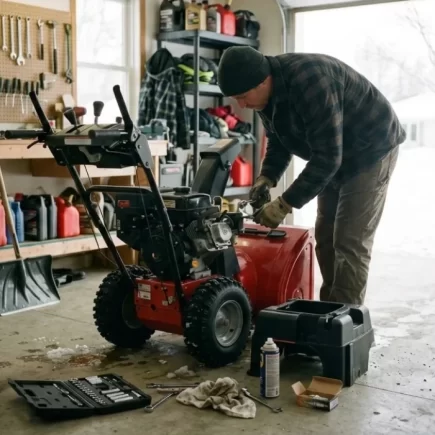
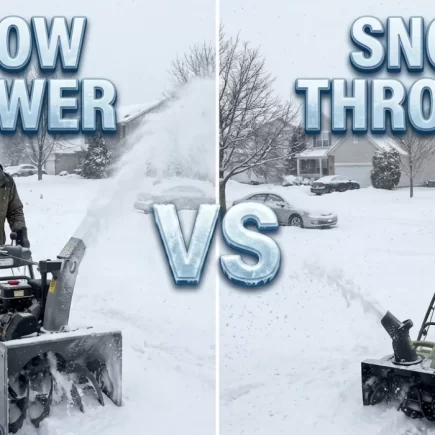
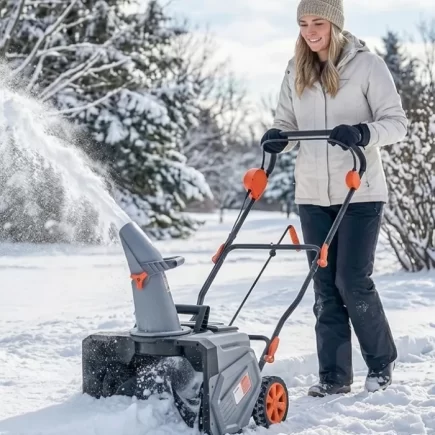




















To fix a snow blower, check the fuel, spark plug, carburettor, belts, shear pins, and chute to identify the cause of the problem. Replace stale fuel, clean clogged components, or replace worn or broken parts as needed. Most common issues can be resolved with basic tools and simple DIY repairs, provided you follow the manufacturer’s safety instructions.
Quick-Glance Summary
| Problem | Most Likely Cause | Fastest DIY Fix |
| Won’t start | Bad fuel, dirty spark plug, or empty primer | Replace the fuel and clean or replace the spark plug. |
| Starts then dies | Clogged carburetor or blocked fuel cap vent | Clean the carburetor and check the fuel cap vent. |
| Won’t start after sitting | Old fuel gummed up the carburetor | Drain the old fuel and clean the carburetor. |
| Surging or running rough | Dirty carburetor or stale fuel | Add fresh fuel and clean the carburetor. |
| Auger not turning | Broken shear pin or worn belt | Replace the shear pins and check the belt. |
| Not self-propelling | Loose or worn drive belt, or worn friction disc | Adjust or replace the drive belt. |
| Chute clogged or won’t rotate | Packed snow or ice, or a dry crank | Clear the snow and lubricate the chute. |
| Not throwing snow far | Worn belt, worn paddles, or wet snow | Replace worn parts and adjust your technique. |
What Tools Do You Need to Fix a Snow Blower?
You need only a few basic tools for most repairs on this list.
| No. | Tool / Supply | Purpose |
| 1 | Spark plug socket and wrench set | Remove and install spark plugs, tighten or loosen bolts. |
| 2 | Screwdrivers (flat and Phillips) | Open covers, adjust cables, tighten screws. |
| 3 | Fuel stabilizer and fresh gas | Prevent fuel breakdown and keep the engine running smoothly. |
| 4 | Carburetor cleaner spray | Clear gum and varnish from fuel system parts. |
| 5 | Replacement shear pins, spark plug, and belts (model-specific) | Swap out worn or broken parts. |
| 6 | Work gloves and safety glasses | Protect hands and eyes during repairs. |
How Do You Diagnose a Snow Blower Problem Step by Step?
To diagnose a snow blower problem, check whether the engine starts, runs smoothly, engages the auger, moves forward, and throws snow effectively. Start with simple checks, such as fuel, the spark plug, and blocked components, before inspecting belts or other mechanical parts.
- Engine will not start: Check the fuel supply, safety key, choke, battery (if applicable), and spark plug.
- Engine starts but stops or runs roughly: Check for stale fuel, a blocked fuel cap vent, a dirty air filter (if fitted), or carburettor problems.
- Auger does not turn: Inspect the shear pins and auger belt for damage.
- Snow blower will not move: Check the drive control, drive belt, and friction disc if your model uses one.
- Snow is not thrown properly: Check for a blocked chute, worn belts or paddles, and unsuitable snow conditions.
What Safety Steps Should You Take Before Fixing a Snow Blower?
Always follow these rules before you touch any part of the machine. Moving parts and hot engines can cause serious injuries.
- Turn the engine off and wait until all parts stop moving.
- Remove the spark plug wire (or the key and battery on electric models) so the machine cannot start by accident.
- Never put your hands inside the chute or auger. Use a stick or a clearing tool instead.
- Work outside or in a room with open doors, because engine exhaust contains carbon monoxide.
- Let the engine cool before you touch the muffler or engine parts.
- Read your owner’s manual for the exact parts and settings on your model.
1. Why Won’t a Snow Blower Start?
A snow blower that won’t start usually has a fuel, spark, or air problem. Check these in order, from easiest to hardest.
Do It Yourself:
- Check that the fuel tank has fresh gas. Gas older than 30 days can go bad.
- Make sure the fuel valve (if your model has one) is open.
- Push the primer bulb 2 to 3 times in cold weather. This sends extra fuel to the engine.
- Set the choke to the “full choke” position for a cold start.
- Make sure the safety key is fully inserted and the stop switch is in the “run” position.
- Pull the spark plug wire off and unscrew the spark plug with a spark plug socket.
- Look at the plug. If it is black, wet, or cracked, replace it with the plug type listed in your manual.
- Put the plug back in, reconnect the wire, and try again.
Electric models: Check that the battery is charged and clicked in all the way. For corded models, test the outlet and extension cord.
2. Why Does My Snow Blower Start and Then Die?
When a snow blower starts and then stops, the engine is not getting a steady flow of fuel. A clogged carburetor or a blocked fuel cap vent is the usual reason.
Do It Yourself:
- Check the fuel cap. Many caps have a tiny vent hole. If it is blocked, fuel cannot flow out of the tank.
- Try loosening the cap slightly while the engine runs. If it keeps running, replace the cap.
- Look at the fuel filter (if your model has one) and replace it if it looks dirty.
- Move the choke to the “run” position after the engine warms up for a minute.
- Spray carburetor cleaner into the air intake while the engine runs. Follow the can’s directions.
- If it still dies, remove the carburetor bowl (the small cup under the carburetor) and clean out any dirt or gunk.
- Rinse the small jet inside with carburetor cleaner and let it dry before you put it back.
3. Why Won’t My Snow Blower Start After Sitting?
Gas goes bad when it sits for months. It turns into a sticky layer that clogs the carburetor. This is the most common problem at the start of winter.
Do It Yourself:
- Drain the old gas from the tank into an approved gas container. Dispose of it at a local hazardous waste site.
- Fill the tank with fresh gas. Use fuel with no more than 10 percent ethanol unless your manual says otherwise.
- Add a fuel stabilizer, following the amount on the bottle.
- Drain the carburetor bowl by loosening the small drain screw at the bottom.
- Replace the spark plug if it is dirty or old.
- Prime the engine, set the choke, and try to start it.
- If it still won’t start, clean the carburetor using the steps in the “starts then dies” section above.
Tip for next year: At the end of winter, either run the engine until the tank is empty or fill the tank with stabilized fuel.
4. Why Is My Snow Blower Surging or Running Rough?
Surging means the engine speed goes up and down. It almost always points to a dirty carburetor or stale fuel.
Do It Yourself:
- Replace the old gas with fresh gas and a fuel stabilizer.
- Check that the choke is fully open. A half-closed choke makes the engine run rough.
- Clean the air filter (if your model has one). Tap off the dirt or replace the filter.
- Check the spark plug and replace it if it is dirty.
- Clean the carburetor, paying close attention to the small jet.
- Check for cracked or loose fuel lines, which can let air in.
5. Why Isn’t a Snow Blower Auger Turning?
The auger is the spinning part at the front that pulls snow in. If the engine runs but the auger does not turn, a shear pin is probably broken. Shear pins are designed to snap on purpose to protect the gearbox when the auger hits something hard.
Do It Yourself:
- Turn off the engine and remove the key or spark plug wire.
- Look at the auger shaft. You will see a small bolt or pin on each side where the auger joins the shaft.
- Check whether either pin is bent or broken. If the auger spins freely by hand, a pin has snapped.
- Remove the broken pin and line up the holes in the auger and shaft.
- Put in a new shear pin that matches your model, and secure it with the cotter pin or nut.
- Clear any ice, sticks, or rocks that caused the problem.
- If the pins are fine, check the auger belt. A loose, cracked, or frayed belt needs to be replaced.
Tip: Keep a few spare shear pins in your garage. They are cheap and easy to swap.
6. Why Won’t a Snow Blower Self-Propel?
On a self-propelled model, the wheels or tracks are driven by a belt and a friction disc. If the auger works but the machine won’t move on its own, the drive system is the problem.
Do It Yourself:
- Turn off the engine and remove the spark plug wire.
- Check the drive control cable. If it is loose, tighten it with the adjuster near the handle.
- Remove the belt cover (usually held by a few bolts) and look at the drive belt.
- Replace the belt if it is cracked, shiny, frayed, or stretched.
- Look at the friction disc, which is a rubber wheel inside the machine. If the rubber is worn smooth or cracked, it needs to be replaced.
- Check that the wheels turn freely and that nothing is stuck in the axle.
- Use your owner’s manual to find the right replacement parts.
7. Why Is My Snow Blower Chute Clogged or Not Rotating?
Wet, heavy snow packs into the chute and freezes. A chute that won’t rotate is often frozen or dry from lack of grease.
Do It Yourself:
- Turn off the engine and wait until the auger stops.
- Use a plastic clearing tool or a long stick to remove packed snow. Never use your hands.
- Spray the inside of the chute with cooking spray or silicone spray to help snow slide out.
- If the chute won’t turn, check for ice around the base and break it up gently.
- Look at the chute crank and gears. Add a small amount of grease or lubricant to help them move.
- Check for bent or damaged parts, and straighten or replace them if needed.
Tip: Spray the chute with silicone spray before each use to prevent clogs.
8. Why Is a Snow Blower Not Throwing Snow Far?
When snow only goes a short distance, the machine is not spinning the snow fast enough, or the snow is too wet and heavy.
Do It Yourself:
- Check the auger belt and impeller belt. Loose or worn belts slip and reduce power.
- Look at the rubber paddles on the auger. If they are worn down, replace them.
- Check the scraper bar and skid shoes. If they are worn out, the machine will not clear snow well.
- Make sure the chute is clear and pointed in the right direction.
- Run the engine at full speed. A low throttle gives weak throwing power.
- Move slower through deep or wet snow so the machine can keep up.
- Take smaller bites of snow instead of a full-width pass.
Is It Better to Repair or Replace a Snow Blower?
Repair your snow blower when the problem is a small part like a shear pin, belt, spark plug, or dirty carburetor. Replace it when the repair costs more than half the price of a new machine, or when the engine or gearbox is badly damaged.
| Situation | Best Choice | Why |
| Broken shear pin, worn belt, or bad spark plug | Repair | The parts are cheap and easy to swap. |
| Dirty carburetor or old fuel | Repair | Cleaning usually fixes it. |
| Engine knocking or metal in the oil | Replace | These signs point to serious internal damage. |
| Cracked or seized gearbox | Replace | Gearbox repairs are costly and rarely worth it. |
| Heavy rust or cracked housing | Replace | The frame is weak and unsafe. |
| Repair cost is over 50 percent of a new machine | Replace | A new unit gives you better value. |
How Much Does It Cost to Repair a Snow Blower?
Snow blower repairs can quickly become expensive when small faults turn into major mechanical problems. Before spending money on repeated repairs, compare the cost of replacement parts and labour with the price of a new machine. Choosing a reliable snow blower before winter arrives can help you avoid unexpected breakdowns when heavy snowfall makes clearing your driveway urgent.
- Minor repairs: Spark plugs, fresh fuel, and basic maintenance may cost relatively little, but neglecting them can lead to bigger problems.
- Mechanical repairs: Worn belts, broken shear pins, and damaged paddles add parts and potential labour costs that can quickly accumulate.
- Major repairs: Carburettor, gearbox, or engine damage may make replacing an older snow blower the more practical choice.
Regular maintenance can help keep your Snow Blowers running efficiently, but frequent breakdowns may indicate that it is time for a replacement. When choosing a new snow blower, consider your driveway size, typical snowfall, clearing width, and power source to find a model that meets your winter snow removal needs.
FAQs
A snow blower can last 10–20 years, depending on its build quality, usage, and maintenance. Regular servicing, proper storage, and timely replacement of worn parts can extend its lifespan. Heavy use and neglected maintenance may shorten its working life.
Inspect your snow blower before each use and follow the manufacturer’s maintenance schedule. Check the auger, belts, shear pins, scraper bar, and chute for damage or wear. Engine models may also require oil changes, spark plug inspections, and fuel-system maintenance.
A battery-powered snow blower can handle a long driveway if its runtime and clearing capacity match the workload. Deep snow, low temperatures, and heavy conditions may reduce battery performance. Compare battery capacity, charging time, clearing width, and spare battery options before choosing a model.