


Last Updated: 04/27/2026

Most customers primarily select a garden swing based on its size, seating capacity, and aesthetic design. However, true day-to-day performance depends on factors that are frequently overlooked: dynamic load distribution, structural stability, and environmental resilience.
This guide explains why some garden swings may feel unstable, lose their structural integrity over time, or wear out faster than expected. Most importantly, we provide a practical evaluation framework based on four critical dimensions:
This guide explains why some garden swings may feel unstable, lose their structural integrity over time, or wear out faster than expected. Most importantly, we provide a practical evaluation framework based on four critical dimensions:

Fit & Suitability
Does it truly complement your available space and suit your lifestyle?
... See More

Safety & Stability
Does the garden swing remain secure and stable under real-world conditions?
... See More

Durability
Can it withstand long-term use and diverse environmental factors?
... See More

Expectations vs. Reality
Do your expectations align with the practical reality of the product?
... See More
Understanding these core principles will help you avoid common purchasing pitfalls and empower you to select a garden swing that maintains its stability and comfort for years to come.
Bodytext title
Most people approach purchasing a swing chair using the same criteria they would apply to a conventional sofa.
👉 Typically, the focus lies on the following aspects:
How many people can it accommodate?
What are the overall dimensions?
How comfortable does the upholstery look?
However, a swing chair is fundamentally different from static furniture. As it is a dynamic construction in motion, specific requirements must be met:
It is under constant dynamic loading.
It interacts directly with the ground and the surrounding environment.
It is subjected to repeated stress cycles over time.
This explains why typical customer feedback often sounds like this:
“It feels a bit wobbly.”
“After a while, it started to squeak.”
“It’s not as stable as I expected it to be.”
👉 In most cases, the issue does not lie with the product quality alone.
👉 Rather, it is a discrepancy between the user’s expectations and the applied physics under real-world conditions.
👉 Typically, the focus lies on the following aspects:
How many people can it accommodate?
What are the overall dimensions?
How comfortable does the upholstery look?
However, a swing chair is fundamentally different from static furniture. As it is a dynamic construction in motion, specific requirements must be met:
It is under constant dynamic loading.
It interacts directly with the ground and the surrounding environment.
It is subjected to repeated stress cycles over time.
This explains why typical customer feedback often sounds like this:
“It feels a bit wobbly.”
“After a while, it started to squeak.”
“It’s not as stable as I expected it to be.”
👉 In most cases, the issue does not lie with the product quality alone.
👉 Rather, it is a discrepancy between the user’s expectations and the applied physics under real-world conditions.
Fit & Sizing: Why a ‘3-Seater’ Doesn’t Automatically Guarantee Comfort for Three
The stated capacity is a maximum limit—not a benchmark for actual seating comfort.
👉 A widespread misconception:
❌ ‘3-Seater’ = Comfortable seating for three adults.
👉 A widespread misconception:
❌ ‘3-Seater’ = Comfortable seating for three adults.
What Truly Determines Comfort
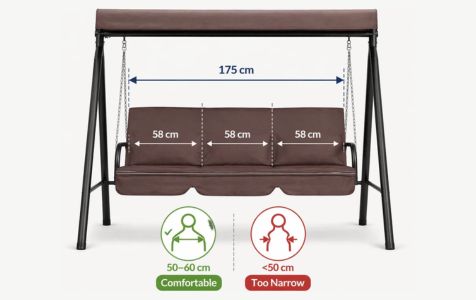
Seat Width per Person
Typical comfort width: 50–60 cm per person.
Many "3-seater" swing chairs compress this space → leading to restricted freedom of movement.
Many "3-seater" swing chairs compress this space → leading to restricted freedom of movement.
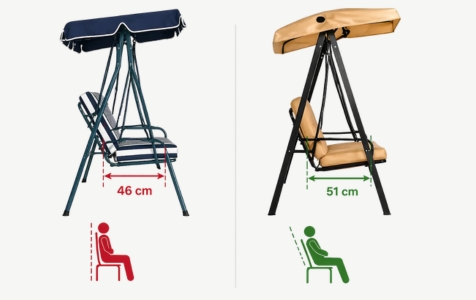
Seat Depth
Shallow seat depth → Encourages an upright posture.
Greater seat depth → Ideal for relaxed or semi-reclined lounging.
Greater seat depth → Ideal for relaxed or semi-reclined lounging.
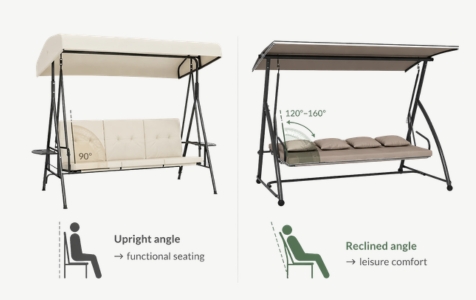
Backrest Angle
Upright angle → Functional seating position (e.g., for reading).
Reclined angle → Maximum leisure comfort for unwinding.
Reclined angle → Maximum leisure comfort for unwinding.
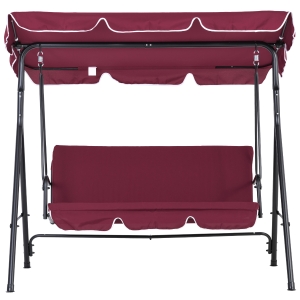
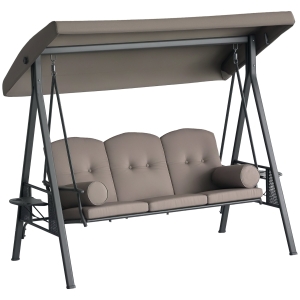
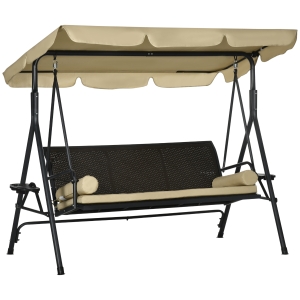
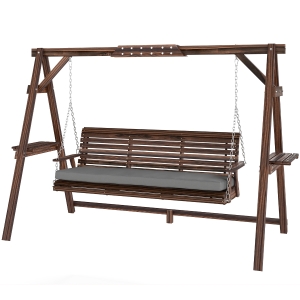
Examples

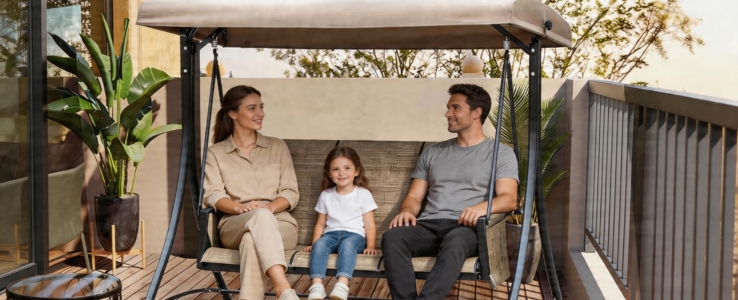
Selecting a Comfortable Swing Chair

Conclusion at a Glance
The dimensions determine whether it fits your garden.
The construction determines how well it performs in daily use.
The construction determines how well it performs in daily use.
Safety: Why Weight Capacity Does Not Equal Genuine Safety
The actual safe load-bearing capacity must always exceed the stated nominal load.
200 kg Load Capacity ≠ Absolute Safety
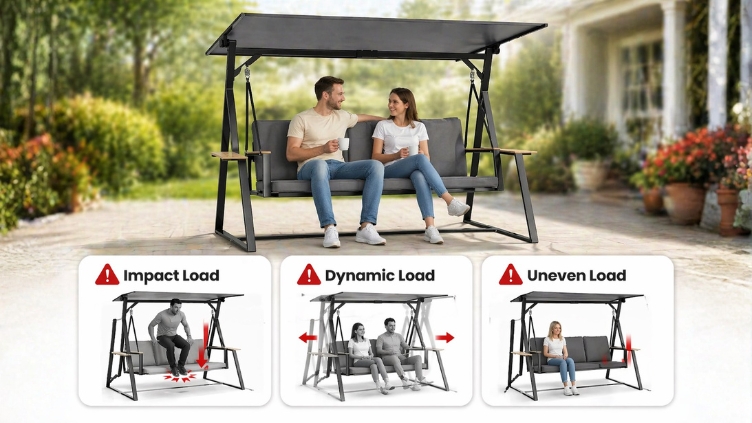

What actually happens during use

Impact Loading
- When someone sits down suddenly
- Creates a short-term peak force
- When someone sits down suddenly
- Creates a short-term peak force
Dynamic Load
- Continuous swinging motion
- Leads to cyclic loading
- Continuous swinging motion
- Leads to cyclic loading
Uneven Loading
- One side is heavier than the other
- Causes torsion and imbalance
- One side is heavier than the other
- Causes torsion and imbalance

Pro Tip
The combination of these acting forces often exceeds the stated nominal load in practice.
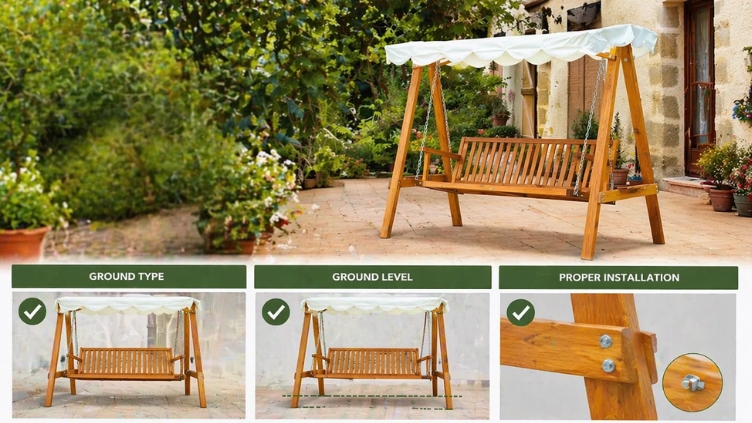

Stability is NOT just a product feature

Ground Type
- Grass → softer, less stable
- Concrete → significantly more secure footing
- Grass → softer, less stable
- Concrete → significantly more secure footing
Levelling
Uneven ground amplifies the wobbling of the structure
Uneven ground amplifies the wobbling of the structure
Anchoring / Fastening
Unfixed frames can shift over time
Unfixed frames can shift over time
Hidden Risks
The real load during use is often higher than expected, especially when:
- Users swing actively and vigorously
- Multiple people sit with uneven weight distribution
- Children use the swing chair dynamically as play equipment
- Users swing actively and vigorously
- Multiple people sit with uneven weight distribution
- Children use the swing chair dynamically as play equipment
Conclusion at a Glance
Stability = Construction × Environment × AssemblyA lack of understanding regarding this equation is the primary reason for perceived ‘instability’.
Durability: Why a Swing Chair Doesn’t Fail ‘Suddenly’
Structural issues develop gradually, rather than instantaneously.
Typical Wear-and-Tear Progression
- Slight Deformation: Usually goes unnoticed at first
- Uneven Load Distribution: The stress begins to shift
- Loose Connections: Screws and joints start to yield
- Warning Signs: Noises, wobbling, or instability occur
- Uneven Load Distribution: The stress begins to shift
- Loose Connections: Screws and joints start to yield
- Warning Signs: Noises, wobbling, or instability occur
What Truly Influences Lifespan?

Frequency of Use
- Occasional Use: Longer lifespan
- Daily Use: Faster wear and tear
- Daily Use: Faster wear and tear

Loading Conditions
- Permanent Maximum Load: Accelerates material fatigue
- Balanced Use: Extends durability
- Balanced Use: Extends durability
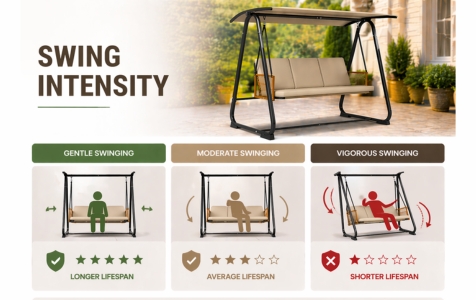
Swinging Intensity
- Gentle Swinging: Minimal stress
- Intensive Swinging: Higher structural fatigue
- Intensive Swinging: Higher structural fatigue
Environmental Factors
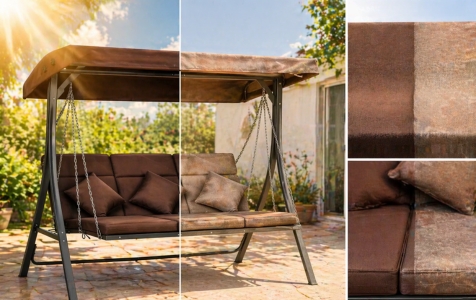

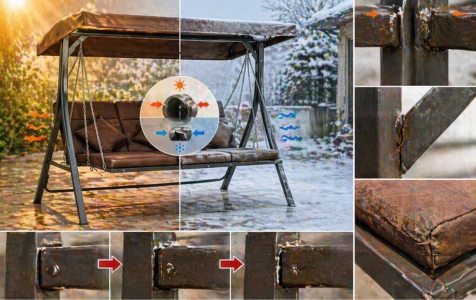
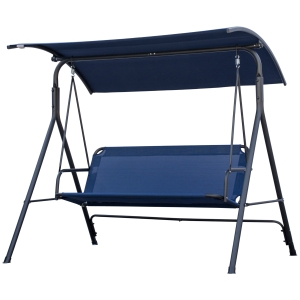
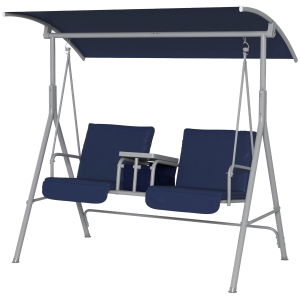
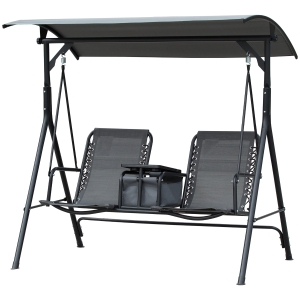
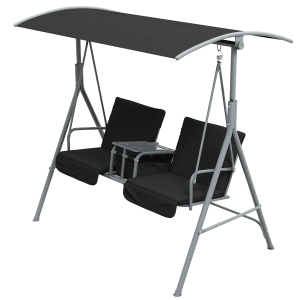
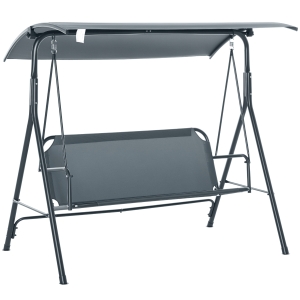
Selecting Durable Swing Chairs
Conclusion at a Glance
Environmental factors often carry more weight than mere product specifications.
Even a robust construction can wear out quickly without proper maintenance.
Even a robust construction can wear out quickly without proper maintenance.
Conclusion: Making Your Choice with Engineering Logic
Stop asking these questions:
- How big is the swing?
- How many people can fit on it?
Ask these instead:
✔ Fit & Sizing
Does it truly align with your available space, your preferred seating position, and your specific usage scenario?
✔ Safety
Will it remain stable under your real-world ground conditions and actual usage patterns?
✔ Durability
Will it withstand your frequency of use and environmental influences over the long term?
✔ Expectation Management
Are you expecting the static stability of a sofa from a dynamic, moving construction?
Final Insight
A swing chair is more than just a piece of furniture; it is a dynamic system operating under real-world conditions.
Shifting from static thinking to a structural understanding is the key to avoiding disappointment and making the right investment.
- How big is the swing?
- How many people can fit on it?
Ask these instead:
✔ Fit & Sizing
Does it truly align with your available space, your preferred seating position, and your specific usage scenario?
✔ Safety
Will it remain stable under your real-world ground conditions and actual usage patterns?
✔ Durability
Will it withstand your frequency of use and environmental influences over the long term?
✔ Expectation Management
Are you expecting the static stability of a sofa from a dynamic, moving construction?
Final Insight
A swing chair is more than just a piece of furniture; it is a dynamic system operating under real-world conditions.
Shifting from static thinking to a structural understanding is the key to avoiding disappointment and making the right investment.